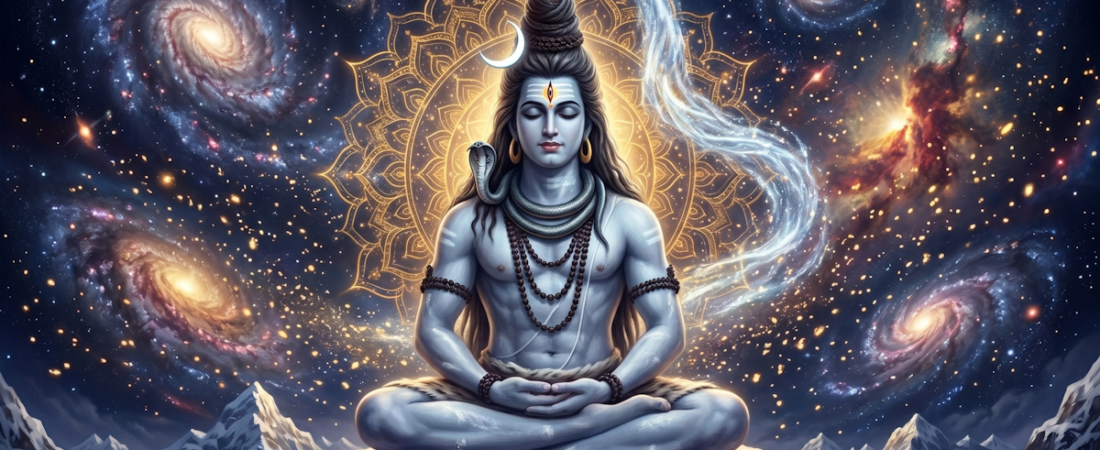
A verse-by-verse journey through eight shlokas on Shiva, the Supreme Soul of all creation
There is a moment in every sincere spiritual seeker’s life when philosophy stops being philosophy and becomes personal. When the ancient question — “Who is God? Where is God?” — stops echoing in the mind and begins to resonate in the chest. It is precisely for that moment that the Shiv Paramatmaashtakam was composed.
Eight verses. Four lines each. One refrain that anchors every verse like an anchor dropped into deep water — शिवाय ते नमो नमः — to You, O Shiva, salutations again and again.
This is not a stotra written in the tradition of elaborate royal praise, full of difficult epithets stacked upon each other like palace towers. This is something quieter and more dangerous — a direct declaration. Shiva is not merely the destroyer in the Hindu Trinity. Shiva is Paramātmā — the Supreme Soul, the ground upon which all existence rests, the one from whom all creation arises and into whom all creation dissolves. These eight verses say exactly that, in plain Sanskrit that any devotee can sing.
Let us walk through them, one by one.
Verse 1 — शिव सर्वत्र हैं: The God Who Hides in Plain Sight
चराचरे जगत्यसौ शिवो वसत्यनन्तकः ।
कणे कणे स्थितो हरः सुसूक्ष्मतोऽपि सूक्ष्मकः ।
हि सर्वमेव शाम्भवं प्रदृश्यमप्रदृश्यकम् ।
शिवाय ते नमो नमः शिवाय ते नमो नमः ॥
The first verse does not begin with Shiva on Kailash. It does not begin with Shiva in the temple. It begins with charāchare jagati — in this moving and unmoving world. It begins here, in the very world you are sitting in as you read this.
शिवो वसत्यनन्तकः — Shiva dwells, the Infinite One. Not dwelt in the past. Not will dwell in some heavenly future. Vasati — present tense, right now, continuously.
Then comes the line that stops you cold: कणे कणे स्थितो हरः — in particle after particle, Hara stands. The Sanskrit word kaṇa means the smallest unit imaginable — a grain, a particle, an atom. Modern physics spent centuries reaching the conclusion that matter at its most fundamental level is energy, vibration, something beyond solid substance. The ancient rishis encoded the same intuition in two words: kaṇe kaṇe.
And the third line is almost shocking in its sweep: हि सर्वमेव शाम्भवं प्रदृश्यमप्रदृश्यकम् — everything that is visible and everything that is invisible is Shambhu alone. Not belongs to Shambhu. Not created by Shambhu. It is Shambhu. This is not theism. This is the edge of non-dualism, and the verse plants us there right from the opening.
The refrain then arrives like a bow after a revelation: शिवाय ते नमो नमः — to You who are everywhere, in whom I already exist, I bow again and again. The bowing is not submission to a distant ruler. It is recognition. Like bowing to a mirror.
Verse 2 — माया और सृष्टि: The Universe as Shiva’s Play
इयं धरा इदं नभः शिवस्य मायया कृतम् ।
अनन्तलोकनिर्माता शिवो लीलाकरो विभुः ।
समस्तलोकपूजितो शिवो देवः सनातनः ।
शिवाय ते नमो नमः शिवाय ते नमो नमः ॥
If the first verse tells us where Shiva is, the second verse tells us what we are standing in. इयं धरा इदं नभः शिवस्य मायया कृतम् — this earth, this sky, made by the Māyā of Shiva.
The word māyā is one of the most misunderstood words in all of Indic philosophy. In popular usage it has come to mean illusion in the sense of something false, something to be dismissed. But in the Shaiva context, māyā is not falseness — it is the creative power through which the Infinite chooses to appear finite, through which the formless takes form. Māyā is not a mistake. It is a performance. And the performer is identified two lines later: शिवो लीलाकरो विभुः — Shiva, the one who performs līlā, the omnipresent one.
Līlā — play, divine sport. This is the word that transforms cosmology into something you can breathe. The universe is not a machine running on cold physics. It is a play being performed, and Shiva is the playwright, the actor, and the stage simultaneously. अनन्तलोकनिर्माता — the creator of infinite worlds, plural. Not one world. Not this solar system. Infinite worlds, and he makes them as play.
समस्तलोकपूजितो शिवो देवः सनातनः — worshipped across all worlds, Shiva the eternal God. Santhali villages and Sanskrit universities, mountain shrines and ocean shores, forest hermitages and city temples — all bend toward the same flame. That is what samasta-loka-pūjita sounds like when you let it fully land.
Verse 3 — शिवोऽहम्: The Most Radical Teaching
अहं शरीरमात्रो न शिवात्मा शाश्वतो ह्यहम् ।
शिवांशरूपको जीवो शिवो जीवो न भिन्नकः ।
शिवोऽहमेव सततं भेदभावो विनश्यतु ।
शिवाय ते नमो नमः शिवाय ते नमो नमः ॥
This is the verse that the ego resists most fiercely, and therefore the one that matters most.
अहं शरीरमात्रो न — I am not merely this body. Four words, and the entire edifice of materialist identity begins to crack. We spend our lives maintaining, decorating, worrying about, and ultimately mourning this body. And the verse opens by saying — that is a case of mistaken identity. Then immediately: शिवात्मा शाश्वतो ह्यहम् — I am the Shiva-Soul, the eternal one.
This is not poetry. This is the central claim of Shaiva Advaita — the non-dual Shaiva philosophy that sees no ultimate separation between the individual soul (jīvātmā) and the Supreme Soul (Paramātmā). शिवांशरूपको जीवो — the living being is a portion, a form, an expression of Shiva. शिवो जीवो न भिन्नकः — Shiva and the Jiva are not different from each other.
This teaching — that you are not separate from the Divine — is the most liberating and also the most demanding thing Shaivism offers. Liberating, because it means your true nature is already pure, already free, already divine. Demanding, because you cannot then live as though you are merely an anxious, mortal creature scrambling for survival.
The third line makes the practical demand explicit: भेदभावो विनश्यतु — let the sense of separateness be destroyed. Not suppressed. Not managed. Destroyed. The Shaiva path is not about tolerating the sense of duality — it is about seeing through it.
And then — and this is the genius of the refrain’s placement here — शिवाय ते नमो नमः. After declaring “I am Shiva,” the verse bows to Shiva. This is not contradiction. This is the paradox at the heart of devotion within non-dual philosophy. The wave bowing to the ocean. Even after knowing it is water, the bow is still beautiful.
Verse 4 — पञ्चभूत और परे: Shiva as the Body of the Universe
जलं वायुः धरा अग्निः गगनं शिवरूपकम् ।
सूर्ये चन्द्रे वसत्येव ज्योतिषां ज्योतिरेव सः ।
कोटिसूर्यसमो देवो न नेत्रेण हि दृश्यते ।
शिवाय ते नमो नमः शिवाय ते नमो नमः ॥
The fourth verse is the cosmological heart of the Ashtakam. It maps Shiva onto reality at every scale — the elemental, the celestial, and the transcendent.
जलं वायुः धरा अग्निः गगनं शिवरूपकम् — water, wind, earth, fire, sky — these are Shiva’s form. The Panchabhuta — the five great elements — are not raw material that Shiva used to build the world and then stepped away from. They are Shiva. The rain on your face is Shiva. The breath in your lungs is Shiva. The ground beneath your feet is Shiva. The warmth of the afternoon sun on your skin is Shiva. The space in which you exist — gaganaṃ — is Shiva.
Then the verse zooms out: सूर्ये चन्द्रे वसत्येव — in the sun and in the moon, Shiva dwells. The Shiva Purāṇa describes the sun and moon as the two eyes of Shiva — the sun being the right eye that burns, the moon being the left eye that soothes. This is why Shiva wears the crescent moon in his matted hair — not as ornament but as symbol of his identity with the cooling, reflective light.
ज्योतिषां ज्योतिरेव सः — he is the light of all lights. This exact phrase — jyotiṣāṃ jyotir — echoes through the Upanishads. It appears in the Bṛhadāraṇyaka Upaniṣad when Yājñavalkya is asked what light the Self moves by. After eliminating the sun, the moon, fire, and speech, he says: the Self is the light. This verse places Shiva as that very Self-light.
And then the verse acknowledges its own limitation: कोटिसूर्यसमो देवो न नेत्रेण हि दृश्यते — equal to crores of suns in radiance, yet this God cannot be seen with the eye. The physical eye that can see the sun cannot see the one who illumines the sun. This is why spiritual practice — meditation, mantra, devotion — is not about acquiring something new. It is about developing a different kind of seeing.
Verse 5 — शिवगीता: The Conversation That Changed Everything
शिवो हि सर्वकारणं यथा रामाय भाषितम् ।
शिवगीतामृतं दिव्यं मुक्तिदं सर्वसाधकम् ।
शिवात् हि सर्वमुत्पन्नं शिवे सर्वं च लीयते ।
शिवाय ते नमो नमः शिवाय ते नमो नमः ॥
This verse carries within it an entire scripture. यथा रामाय भाषितम् — as was told to Rāma. This is the reference to the Shiva Gītā, a text found within the Padma Purāṇa, in which Shiva himself appears before Rāma — not the other way around — and reveals the supreme knowledge of his own nature.
The Shiva Gītā is among the most philosophically dense texts in the Shaiva canon. In it, Shiva declares himself to be the Paramātmā — not a deity alongside Brahma and Vishnu, but the ultimate ground from which all three arise. The verse distills this entire revelation into one line: शिवो हि सर्वकारणं — Shiva alone is the cause of everything.
शिवगीतामृतं दिव्यं मुक्तिदं सर्वसाधकम् — the divine nectar of the Shiva Gītā, giver of liberation, the means for all seekers. The word amṛta — nectar, immortality — is used here not casually. In Vedic cosmology, amṛta is the substance that defeats death. The teaching of the Shiva Gītā is called amṛta because understanding it dissolves the root cause of all suffering: the mistaken belief that we are separate from the Divine.
शिवात् हि सर्वमुत्पन्नं शिवे सर्वं च लीयते — from Shiva alone all things arise, and in Shiva all things dissolve. This is the Shaiva cosmological cycle stated with perfect economy. Śrṣṭi (creation), sthiti (maintenance), and laya (dissolution) — all three are Shiva. He is not the deity of one phase. He is the ground of all phases. This understanding is what the Shaiva tradition calls paripūrṇa darśana — the complete vision.
Verse 6 — करुणा की गहराई: The Ocean That Runs to Shore
कृपासिन्धुर्दयानाथो दीनबन्धुर्हरः शिवः ।
स भक्तवाणीं सदा श्रुत्वा शीघ्रमेव हि आगतः ।
निराकारोऽपि भक्तार्थं रूपं धरति शंकरः ।
शिवाय ते नमो नमः शिवाय ते नमो नमः ॥
After five verses that climb the heights of philosophy and cosmology, the sixth verse does something utterly unexpected — it brings Shiva running.
कृपासिन्धुर्दयानाथो दीनबन्धुर्हरः शिवः — Shiva the Hara, the ocean of compassion, the master of mercy, the friend of the destitute. Three epithets in one line: kṛpāsindhu (ocean of compassion), dayānātha (lord of mercy), dīnabandhu (friend of the poor and broken). These are not royal titles. These are the titles of someone who sits with you in the dirt.
स भक्तवाणीं सदा श्रुत्वा शीघ्रमेव हि आगतः — always hearing the devotee’s voice, he comes quickly. Śīghrameva — quickly, immediately. The word is almost startling. We think of the Divine as patient, slow, working across cosmic timescales. And yet here the verse says: when a devotee calls, Shiva comes quickly. The Shiva Purāṇa contains story after story of exactly this — of ordinary people, broken people, sinful people calling out and Shiva appearing, sometimes mid-sentence.
निराकारोऽपि भक्तार्थं रूपं धरति शंकरः — though formless, for the sake of devotees, Shankara takes form. This single line contains the entire theology of the Shaiva Saguna-Nirguna debate resolved in one breath. Yes, Shiva is ultimately formless — nirākāra, beyond all attributes, beyond all description. And yet. For the devotee who needs a face to look at, a form to hold, a murti to weep before — for that devotee, Shankara takes form. The Infinite becomes finite not because it is limited but because love is generous.
This is perhaps the most emotionally powerful verse of the Ashtakam. It is the verse that should be sung slowly, with weight on every syllable.
Verse 7 — निर्लिप्त और फिर भी भक्तवश: The Paradox of the Ascetic God
भस्मधारी जटाधारी शोभनो शिवशंकरः ।
मायातीतो विरक्तो हि निर्ममो शंकरो हरः ।
भक्तहेतोर्हि नियमं त्यजते भक्तवत्सलः ।
शिवाय ते नमो नमः शिवाय ते नमो नमः ॥
The seventh verse gives us the image that the world most immediately recognizes as Shiva — and then subverts it.
भस्मधारी जटाधारी शोभनो शिवशंकरः — the wearer of ash, the bearer of matted locks, the beautiful Shiva Shankara. These two marks — bhasma and jaṭā — are not mere iconography. They are philosophical statements worn on the body.
Bhasma is the ash that remains after everything burns. It is what survives cremation — the pyre that consumes desire, attachment, ego, and the body itself. When Shiva smears himself in ash, he is wearing the ultimate truth of impermanence. Everything becomes this. Everything returns to this. He reminds us not through words but through his very appearance.
Jaṭā — the matted, uncombed, undecorated hair of the ascetic. In Vedic culture, groomed hair signified social belonging, householder status, participation in the world of ambition and obligation. The ascetic’s jaṭā signals total detachment from that world. Shiva as Mahāyogi sits beyond the game entirely. मायातीतो विरक्तो हि निर्ममो शंकरो हरः — beyond māyā, fully detached, without possessiveness — this is Shankara.
And then the third line lands like a thunderclap: भक्तहेतोर्हि नियमं त्यजते भक्तवत्सलः — for the sake of devotees, this same being of total detachment abandons even his own rules. Bhaktavatsala — tender and loving toward devotees as a cow toward her calf. The ascetic who needs nothing becomes the God who gives everything. The one who is unmoved by the three worlds is moved by a devotee’s tears.
This is the great paradox of Shiva-bhakti and it is not a contradiction. It is the demonstration that love is not a weakness in the Divine. Love is how the Infinite chooses to express itself when it looks at a sincere heart.
Verse 8 — यह जन्म सफल करो: The Final Call
भुवि जातो हि मानवः शिवं भजेत सर्वदा ।
परमात्मा हि यो देवः तं शिवं पूजयेत् सदा ।
जन्मपापं हरत्येव मोक्षदाता सदाशिवः ।
शिवाय ते नमो नमः शिवाय ते नमो नमः ॥
The eighth verse is not philosophical. It is personal. It speaks directly to whoever is listening.
भुवि जातो हि मानवः शिवं भजेत सर्वदा — every human being born on this earth must worship Shiva always. The word mānava — human being — comes from Manu, the first man, meaning one who thinks, one who reflects. Of all the life-forms on earth, only the human has the capacity to ask “Who am I? What is this? Why does anything exist?” And it is precisely that capacity that makes human birth rare, precious, and — the verse implies — obligated.
परमात्मा हि यो देवः तं शिवं पूजयेत् सदा — knowing that this God is the Paramātmā, let one worship that Shiva always. The word vijñāya — having known, having understood — is crucial. This is not blind ritual obedience. This is worship that arises from understanding. Worship that knows why it is bowing. That quality of understanding is what distinguishes devotion from superstition.
जन्मपापं हरत्येव मोक्षदाता सदाशिवः — destroying the sins of birth upon birth, Sadashiva is the giver of liberation. Janmapāpam — the accumulated residue of countless births, the karmic weight we carry across lifetimes without even knowing it. And Sadashiva, the eternally auspicious one, dissolves it. Not reduces it. Not lightens it. Harati — carries it away, removes it entirely.
The verse ends — as every verse ends — with शिवाय ते नमो नमः. But here, at the close of the eighth verse, after everything that has been said, the refrain means something different than it did in the first verse. In the first verse it was recognition. Here, at the end, it is surrender. Complete, joyful, final surrender. The kind that feels not like defeat but like the deepest relief imaginable.
The Refrain That Holds Everything Together
शिवाय ते नमो नमः शिवाय ते नमो नमः
It is worth pausing specifically on the refrain, because it is what makes this Ashtakam singable rather than merely recitable.
Śivāya — to Shiva, the auspicious one, the one who is welfare itself. Te — to you, second person, intimate, direct. Not “to the Lord” in the third person, distant and formal. To you. Face to face. Namo namaḥ — salutations, bowing, again and again.
The doubling — namo namaḥ — is not redundancy. In Sanskrit devotional poetry, repetition is emphasis and it is music. The second namaḥ is the echo of the first, the bow that deepens after the first bow has already touched the ground. In bhajan tradition, this kind of refrain is called ṭeka — the anchor, the return point, the melodic home base to which every verse comes back.
When singing this Ashtakam, the tradition is for the main singer to carry verses one through three, and for the assembly to join on the refrain. By the second verse, this becomes instinctive. By the fifth, the refrain has become a groove that the mind settles into between the verses like settling into the breath between words. This is the technology of the refrain — it regularizes the nervous system, it creates a shared sonic space, and it trains the attention to return, again and again, to the same point. Which is, of course, exactly what meditation does.
Why This Ashtakam Matters Now
We live in a time of extraordinary noise. Spiritual content is produced industrially — YouTube channels, Instagram reels, podcast episodes on Vedanta, animated Purana stories, AI-generated devotional music. All of it has value and some of it has great value. But there is a specific danger in abundance: that we consume without absorbing, that we appreciate without practicing, that we understand intellectually what we have never let touch us personally.
The Shiv Paramatmaashtakam is not asking to be consumed. It is asking to be inhabited.
Each of its eight verses is a complete teaching. Verse three alone — शिवोऽहमेव सततं भेदभावो विनश्यतु — could sustain a lifetime of contemplation. The declaration “I am Shiva, let the sense of separateness be destroyed” is not a statement to be understood once and filed away. It is a practice. It is something to return to every morning, every evening, every time the anxiety and smallness of ordinary self-sense comes rushing back.
Sing it in Bhairavī at dawn. Let the soft komal swara — the flattened Ga, the flattened Dha — carry the words into the quieter parts of yourself that waking life rarely reaches. Let the refrain become the breath between thoughts. Let शिवाय ते नमो नमः become the punctuation between moments, the comma between one activity and the next.
This is how Sanskrit devotional poetry was designed to work. Not as art to be appreciated from a distance. As medicine to be taken internally, repeatedly, until the disease of forgetting one’s own divine nature is permanently cured.
A Final Word
Lord Shiva, the Paramātmā of this Ashtakam, is not a distant God. He is the one described in verse one as living in every particle of existence — कणे कणे स्थितो हरः. He is the one who, in verse six, comes running when called — शीघ्रमेव हि आगतः. He is the one who, in verse seven, breaks his own rules for a devotee’s sake — भक्तहेतोर्हि नियमं त्यजते.
This is not the God of cosmic indifference. This is the God who is simultaneously the foundation of the universe and the most personally available presence you can call upon. Shiva as Paramātmā and Shiva as Bhaktavatsala — both are true, both are complete, and both are available to you right now, in this moment, in this body, in this life.
That is what the eight verses are really saying. And शिवाय ते नमो नमः is how we say: we heard you.
॥ ॐ नमः शिवाय ॥
हर हर महादेव
Estimated reading time: 14 minutes