

A story that transcends religion, crosses continents, and defies all rational explanation.
Estimated reading time: 6 minutes
The Year Was 1819
India was bleeding under colonial rule. British officers marched across her ancient soil, building churches, enforcing laws, and dismissing her gods as superstition. It was an era of conquest — not just of land, but of belief.
In the midst of this turbulent time, a British Army officer named Lieutenant Colonel Alfred Robert Martin was posted in Agar Malwa, Madhya Pradesh. He was a soldier of the Crown — pragmatic, disciplined, trained to believe in guns and orders, not gods and miracles.
And yet, what happened to him would shake that certainty to its core.
A Wife Left Waiting
While Colonel Martin fought on distant frontiers, his wife remained behind in Agar Malwa, alone with her fear. For months, letters had arrived regularly — reassurances, updates, the small comforts a soldier sends home from war. Then, without warning, the letters stopped.
Weeks passed. Then more weeks. Silence.
No news of victory. No news of defeat. No news at all.
She did not know if her husband was alive or buried in some nameless Afghan valley. Grief and helplessness consumed her. In that state of utter despair, she wandered out one evening — and heard something unexpected.
The sound of chanting.
The Temple She Never Expected to Enter
The sound led her to a small Shiva temple, alive with the fragrance of incense and the rhythm of the Panchakshara mantra — Om Namah Shivaya. She stepped inside hesitantly, a British woman in a Hindu temple, perhaps feeling like a trespasser.
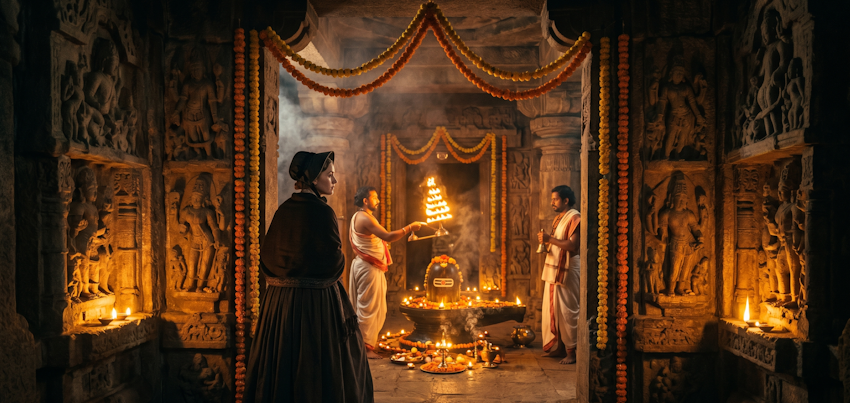
The priests noticed her distress. They spoke to her gently. They told her about Bholenath — the innocent one, the compassionate one — who holds no boundaries of caste, creed, or country. They told her that Mahadev answers every sincere heart that calls to him.
Something in those words broke through every barrier of culture and religion she carried.
She folded her hands. She prayed — not in the language of theology, but in the oldest language known to humans: desperate, unconditional love for someone she might lose.
For eleven days, she returned to that temple. For eleven days, she chanted Om Namah Shivaya with everything she had.
On the eleventh day, a messenger arrived at her door — carrying a letter from her husband.
What the Letter Said
Colonel Martin’s letter described something that no military training could have prepared him to write.
His battalion had been surrounded by Pathan warriors in Afghanistan. Casualties were mounting. Escape routes were cut off. Martin himself had resigned to the possibility that he would not return home. He closed his eyes and waited for the end.
Then — something extraordinary happened.
Out of nowhere, a tall and commanding figure appeared on the battlefield. He had long matted hair. His body was smeared with ash. In his hand, he carried a trident — a trishul — which he wielded with impossible, devastating grace.
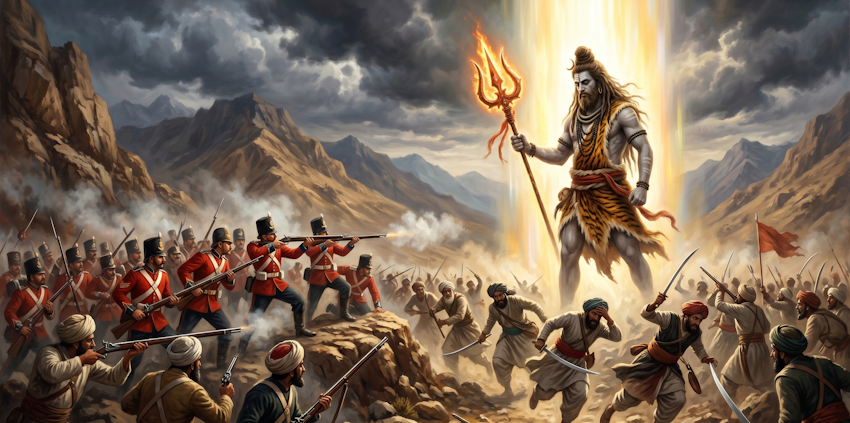
The Pathans, hardened warriors who feared nothing, took one look at this figure and fled in terror.
In the sudden silence, the mysterious warrior turned to Colonel Martin and spoke:
“Do not be afraid. Your wife’s prayers have pleased me greatly.”
And then he was gone.
Martin, a man who had never worshipped Shiva, who may have never even heard of the Panchakshara before, wrote in that letter exactly what he had seen — a yogi in a tiger skin, bearing a trident, with ash-smeared skin. The description was unmistakable to anyone who knew.
It was Lord Shiva himself.
The Return and the Promise
When Colonel Martin finally returned to Agar Malwa, his wife read him her account of the eleven days of prayer. As she spoke, Martin’s face changed. The dates matched perfectly. The day the mysterious warrior appeared on the Afghan battlefield was the same day his wife completed her eleven-day vigil.
Neither of them needed any further proof.
The officer who had come to India as a representative of a colonial empire — a man who had likely dismissed Indian faith as primitive — sat down in gratitude before the deity who had saved his life without being asked, without any prior devotion, simply because a wife had loved deeply enough.
Together, Martin and his wife decided to rebuild and restore the ancient Baijnath Shiva temple in Agar Malwa. He spent his own resources on the reconstruction. He, a British Christian officer, became the patron of a Shiva temple in colonial India.
After completing the temple, both returned to England — but they carried something home that no ship could have brought to India: living faith in Mahadev.
The Temple That Still Stands
The Baijnath Shiva temple in Agar Malwa, Madhya Pradesh, stands to this day. And on its walls, this entire story is inscribed — not as legend, not as mythology, but as historical testimony by the man who experienced it.
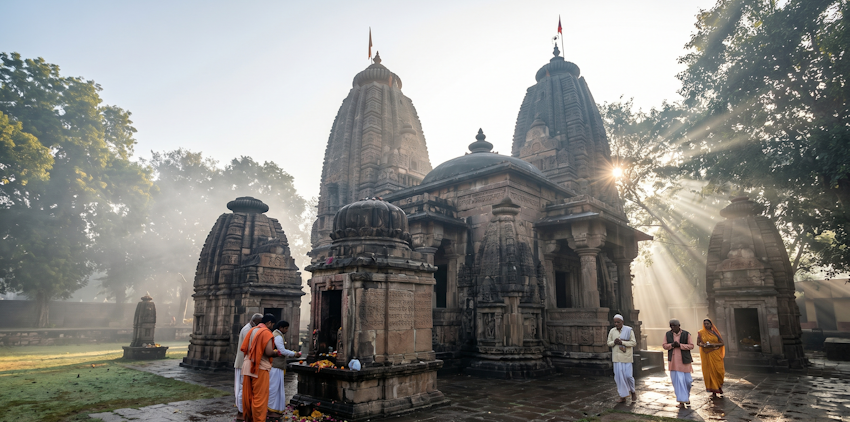
It remains the only temple in India built or restored by a British officer during the colonial period. And perhaps more remarkably, it is the only place in the world where a foreign soldier’s encounter with a Hindu deity is recorded in stone — in his own words.
If you ever visit Agar Malwa, go to this temple. Read those walls. Stand in the same space where an English woman once knelt before a god she didn’t know — and was heard anyway.
What This Story Really Tells Us
Mahadev has no religion. He has no preference for birth, nation, or creed. The only language he responds to is sincerity — the raw, trembling honesty of a heart that has nowhere else to go.
Colonel Martin’s wife didn’t know the rituals. She didn’t know Sanskrit. She didn’t understand the theology of Shaivism. But she loved her husband, and she prayed with everything she had.
That was enough.
That has always been enough.
हर हर महादेव।
He who is the Lord of all — belongs to all.