
From the Vayaviya Saṃhitā of the Shiva Purana — the most tender and fierce devotional story ever told
There is a story in the Vayaviya Saṃhitā of the Shiva Purana — tucked within Chapters 34 and 35 — that has never aged. It begins not with a warrior, not with a god, not with a cosmic event, but with a small, hungry boy and a cup of rice-water that tasted nothing like milk. From this utterly ordinary moment of childhood disappointment, one of the greatest devotional journeys in all of Puranic literature unfolds. This is the story of Upamanyu — the child who set out to ask Lord Shiva for an ocean of milk and received, instead, the entire cosmos.
The Shiva Purana presents this narrative through a remarkable frame: it is told by the sage Upamanyu himself, grown old and luminous, to none other than Lord Krishna, who comes to him at Kailasa seeking guidance on how to please Mahadeva. What Krishna hears — and what we now receive — is a story of childhood poverty, unwavering faith, a terrifying test, and the incomparable grace of Lord Shiva.
The Cup of Rice-Water and a Mother’s Tears
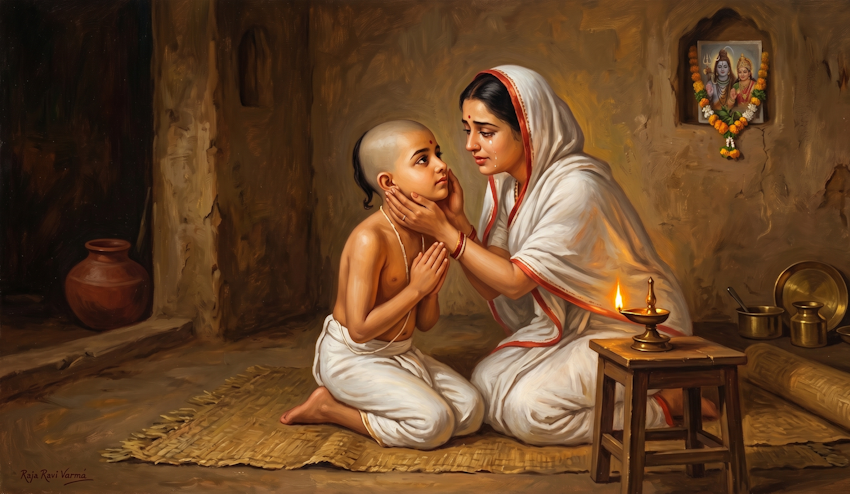
Upamanyu — whose name in Sanskrit means “the zealous one” — was the son of the great sage Vyāghrapāda, a Siddha of immense power. But despite his father’s spiritual eminence, the family lived in deep poverty. The ashrama lacked cows. There was no milk. And so when the boy, one ordinary afternoon, came home from a visit to his uncle’s hermitage with the taste of real milk still on his tongue and asked his mother for the same, she could only offer him what she always had: rice flour mixed with water, shaped to look like milk, a loving deception born of poverty.
Upamanyu tasted it and knew immediately it was not milk. He said nothing harsh. He was a Brahmin child raised on truth. Instead, he looked at his mother with wide eyes and said: “This is not milk.”
His mother could not bear it. She broke down and told him the truth — that they were poor, that real milk was beyond their reach, that she had been mixing rice powder in water for years and hoping he would not notice. She wept.
“Don’t cry, please,” said the boy Upamanyu. “I will pray to Shiva and get milk for myself.”
— Shiva Purana, Vayaviya Saṃhitā, Chapter 34
This response — from a child to a weeping mother — is the first revelation of who Upamanyu truly is. Not despair. Not anger at fate. Not resignation. But immediate, calm, absolute faith in Lord Shiva. His mother, recognizing the divine spark in her son, dried her tears and did something profound: she taught him two mantras. The first was the Pañcākṣarī — the sacred five-syllable incantation Om Namaḥ Śivāya. The second was the Aghorāstra mantra — a terrible divine weapon-invocation, to be used only in mortal danger. Thus armed with devotion and protection, the boy left for the Himalayas.
The Himalayan Tapas: Living on Air and the Name of Shiva
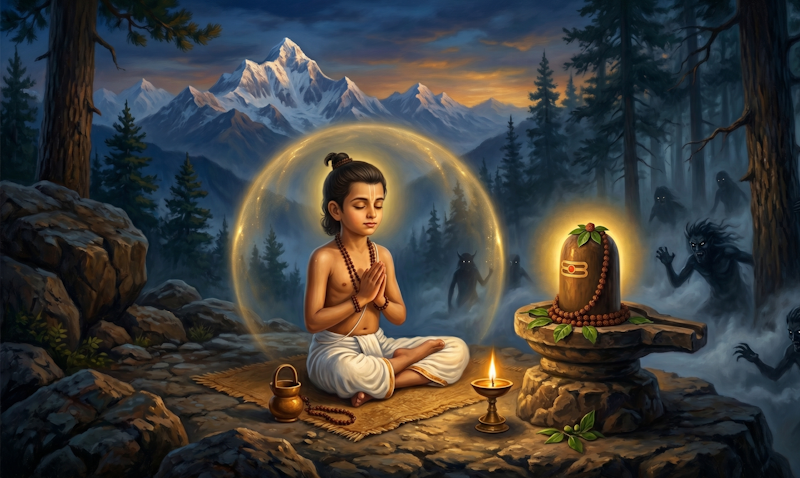
Upamanyu arrived in the Himalayas and did what his mother had taught him. He fashioned a Shivalinga from the earth beneath his hands — not marble, not stone quarried from a sacred mountain, but simple clay — and placed it before him. He sat. He chanted Om Namaḥ Śivāya. He gave up food entirely, sustaining himself on nothing but air and the name of Shiva.
The Shiva Purana tells us that his tapas was of extraordinary intensity. So fierce was the heat of his penance that its spiritual energy began to scorch the heavens themselves — Devaloka began to burn. The celestial realms trembled. The gods, alarmed and scorched, hastened to Vaikuṇṭha to inform Lord Vishnu. Vishnu, understanding the gravity of the situation, proceeded directly to Kailasa to inform Lord Shiva Himself.
But before the gods could act, something else came first: demons. Sent by the sage Marichi, ghostly figures arrived at Upamanyu’s meditation site to disturb, frighten, and break his tapas. They howled. They manifested terrifying forms. They tried every trick of supernatural disturbance. Upamanyu did not open his eyes. The five-syllable mantra continued, steady as a river. The demons failed utterly.
He lived only on air and chanted the incantation his mother had taught him. He prayed before an earthen linga. Demons came to disturb his meditation. Upamanyu paid no attention to them.
— Shiv Puran, Vayaviya Saṃhitā, Chapter 34
This is the second revelation of the story: that the name of Shiva, chanted with complete sincerity, is its own armour. No weapon of darkness can penetrate the field of Namaḥ Śivāya. The demons retreated. Upamanyu sat on.
Shiva Disguised as Indra: The Supreme Test
Lord Shiva was deeply moved. The Shiva Purana says that Mahadeva was impressed — and then, characteristically, decided He would test His young devotee before revealing Himself. This is the nature of Shiva’s grace: it does not arrive without first verifying that the devotee’s love is unshakeable, not a matter of convenience or fear.
Shiva assumed the disguise of Indra, King of the Gods, dressed in celestial splendour, radiant and commanding. He appeared before the meditating boy and spoke with the authority of heaven itself.
“Upamanyu!” he called. “What are you doing? I am pleased. Ask for a boon.”
The boy, overjoyed that the King of Gods had descended before him, replied with humility: “I am blessed that the lord of the heavens has come to me. I am praying to Shiva, and I ask only for devotion to Him as my boon.”
Then came the test. The disguised Shiva curled his lips and asked: “Shiva? Why do you pray to that useless fellow?” And he proceeded — in the manner of a tempter — to disparage Lord Shiva. He named Shiva’s unconventional nature: His association with cremation grounds, His ash-smeared body, His wandering with ghosts and goblins, His elephant-hide garment. “I am Indra,” the disguised voice said. “Ask a boon of me instead. Why waste your devotion on such a one?”
What happened next is one of the most electric moments in all of Puranic literature.
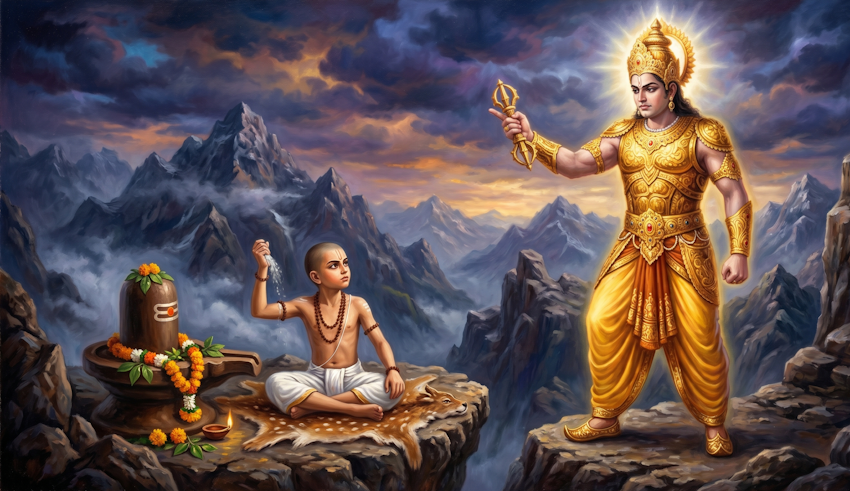
Upamanyu could not bear it. He did not negotiate. He did not politely disagree. The boy’s love for Shiva was not philosophical — it was visceral, total, and righteous. He rose from his meditation. He chanted the Aghorāstra mantra his mother had taught him — the terrible weapon-invocation — and charged the sacred ash in his palm with its power. He aimed the divine missile directly at the one he believed was Indra, shouted his defiance to the heavens, and released it — prepared, if necessary, to burn the King of Gods for insulting his Lord.
Upamanyu held the fiery missile ready for discharge. He remembered the feet of Śiva and attempted to burn off his body in sacrifice. The boy who had come only for milk was now willing to give up everything for the honour of his Lord.
— Shiva Purana, Vayaviya Saṃhitā, Chapter 35
Scriptural Reference
The chapters 34 and 35 in Section 7.1 of the Vayaviya Saṃhitā of the Shiva Purana contain the story of Upamanyu — the Shiva Purana’s account being detailed and comprehensive, while the Linga Purana contains a parallel condensed version acknowledged as an abridgement.