
What the Vidyeśvara Saṃhitā of the Shiva Purana reveals about the supreme power of attentive listening
Every morning, when a bhajan to Mahadeva drifts through the air — from a nearby temple, a radio in a neighbouring home, or your own playlist — something subtle happens within you. The mind slows. The noise of the day recedes. And for a moment, even without conscious effort, you are drawn toward Him. This is not mere sentiment. The Shiva Purana tells us it is śravaṇa — the ancient, grace-given faculty of listening — doing exactly what it was always meant to do.
“Listening to anything about Shiva with a focused and loving mind — whether it is a story, a teaching, or even just hearing someone talk about Him — brings one closer to Shiva. It is like a lover listening to all the stories and talks of his beloved.”
— Vidyeśvara Saṃhitā, Chapter 4 (Lord Brahmā to the assembled sages)
The Three Limbs of Bhakti: A Framework from the Shiv Puran
In the third and fourth chapters of the Vidyeśvara Saṃhitā, Lord Brahmā instructs a congregation of sages who had come to him troubled — each holding their own philosophical view, none finding peace. His answer is precise: the path to Shiva rests on three interlocked practices.
- Śravaṇa: Attentive listening to Shiva’s glory, names, stories, and teachings — from a teacher, scripture, or devotional song.
- Kīrtana: Expressing love for Shiva through singing, recitation, or speech — in any language, in any voice.
- Manana: Deep, sustained contemplation of Shiva’s qualities and nature — the mind dwelling in Him the way it dwells in what it loves most.
Brahmā is explicit about the sequence: śravaṇa comes first. Without it, kīrtana has no content to sing from, and manana has no object to hold. He calls śravaṇa “the most important first step,” the one that makes all others possible.
Listening Is Not Passive — It Is a Spiritual Act
We often think of listening as the easy part, the default, the thing that happens before the “real” practice begins. The Shiv Puran upends this. Brahmā teaches that the capacity to listen to Shiva with a “focused and loving mind” is itself a gift of Shiva’s grace. You cannot manufacture it through will alone. It is granted.
This creates the beautiful paradox that the Puran places at the heart of devotion: grace enables śravaṇa, and śravaṇa deepens grace. Just as Brahmā explains to the sages — “devotion comes from the grace of Shiva and His grace is the result of devotion, just like how seed produces sprout and sprout produces the seed” — śravaṇa is both the beginning of the cycle and its flowering.
“The more you listen with a calm and attentive heart, the closer you get to Shiva. It becomes easier as one associates with good people who are already on their path.”
— Vidyeśvara Saṃhitā, Chapter 4
Vyāsa’s Own Crisis — and the Counsel of Nandikeshvara
The Purana offers a striking story to ground this teaching in lived experience. Vyāsa — the very compiler of the Vedas, the sage of sages — found himself agitated and spiritually adrift while performing tapas on the banks of the Sarasvatī. His erudition was not enough. His penances were not enough.
It was Sanatkumāra who came to him, and Sanatkumāra’s own clarity had come from Nandikeshvara, Shiva’s foremost attendant. The instruction passed down through this luminous chain was the same three words: śravaṇa, kīrtana, manana. Even the greatest scholar needed to hear Shiva’s glory spoken aloud before his mind could settle into contemplation.
If Vyāsa needed śravaṇa, so do we.
Why a Daily Bhajan Practice Is Exactly This
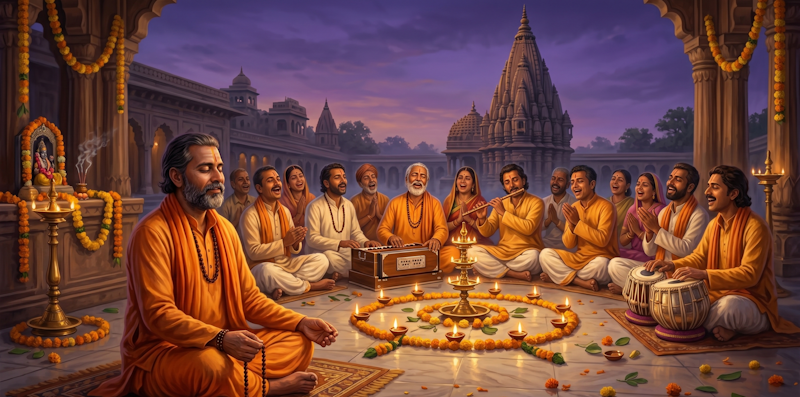
A Shiv bhajan is not merely music. In the framework of the Vidyeśvara Saṃhitā, it is śravaṇa and kīrtana simultaneously — Shiva’s names, His leelās, His qualities, set to rāga and tāla so that they enter the mind through the ears and the breath together. When you listen to a bhajan with even a fraction of the “focused and loving mind” Brahmā describes, you are on the path the Purana lays out.
The Purana also assures the sincere seeker that the initial difficulty eases with satsanga — the company of those already walking this road. A daily bhajan practice, whether alone or in community, creates precisely this field. The sound of Shiva’s names morning after morning begins to settle the mind, as Brahmā promises, into a state the text calls Shiva Yoga — unification with Shiva — and through it, “supreme bliss, free from all suffering.”
A Practice, Not a Performance
One of the quiet wisdoms of Chapter 4 is its universality. Kīrtana, Brahmā says, “can be done in any language.” There is no gatekeeping of pronunciation, no prerequisite of Sanskrit mastery. The heart’s sincerity is the qualification. This means your daily Shiv bhajan — in Hindi, in Bengali, in Tamil, hummed in the kitchen at dawn — counts. The Purana says so.
Begin small. Five minutes of attentive listening to a bhajan before the day’s demands arrive. Let the names of Mahadeva enter through the ears first. The Vidyeśvara Saṃhitā promises that from this single seed, contemplation will grow on its own — because Shiva Himself will tend it.
References:
- Shiva Purana, Vidyeśvara Saṃhitā, Chapters 3–4 (Brahmā’s discourse to the sages; the story of Vyāsa, Sanatkumāra, and Nandikeshvara).
- Nārada Bhakti Sūtra (sūtras 36–37) on śravaṇa-kīrtana as the supreme means;
- Bhāgavata Purāṇa 7.5.23 (Prahlāda’s ninefold bhakti) where śravaṇaṁ kīrtanaṁ viṣṇoḥ is the foundational pair.