
From the Shiva Purana and Linga Purana to the Maheshvara Sutras — the cosmic secrets encoded in every beat
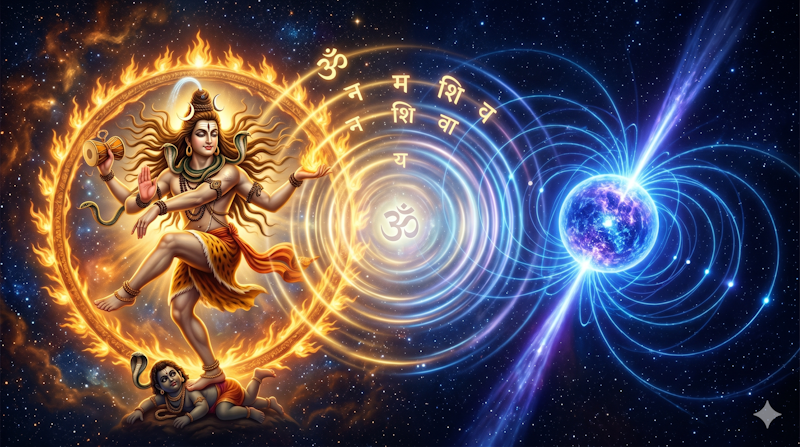
When Lord Shiva dances His Tandava and the Ḍamaru sounds, something happens that no physics laboratory has yet measured and no philosophy has fully named. The entire universe vibrates. Galaxies pulse. The individual soul trembles awake. This is not poetry. This is what the great Puranas, the Agamas, and the oldest grammatical tradition of humanity tell us — that the sound of the Ḍamaru is not an instrument’s note, but the primal act of creation itself.
For most devotees, the Ḍamaru is the drum held in Mahadeva’s upper right hand, the one that beats as He dances. But the Shiva Purana, the Linga Purana, the Maheshvara Sutras, and the deep philosophy of Kashmir Shaivism converge on a staggering revelation: the Ḍamaru is not a drum. It is a cosmological event.
What the Shiva Purana Tells Us: The Ḍamaru of Nataraja
The Shiva Purana’s Rudra Saṃhitā describes Lord Shiva in His Nataraja form — the Lord of Dance — whose every movement governs the five cosmic acts: sṛṣṭi (creation), sthiti (preservation), saṃhāra (dissolution), tirobhāva (concealment), and anugraha (grace). Among all the symbols in this supreme iconography, it is the Ḍamaru held in the upper right hand that carries the first and most foundational of these acts — creation.
“The sound of the Ḍamaru signifies Śabda Brahman — the undifferentiated cosmic sound that becomes differentiated through the vibrations of His sacred drum. All the Sanskrit alphabets have come out of the play of the Ḍamaru. Creation arises from Ḍamaru.”
— Shaiva commentary on the Nataraja form, drawing from the Shiva Purana and Shaiva Āgamas
The Shiva Purana is unambiguous: the Ḍamaru held aloft by Nataraja is the source of the primordial sound called Nāda — the first vibration that arose in the void before existence began. Mahadeva began His dance of creation to the rhythm of this drum, and from that rhythm, the cosmos sprang into being. Every beat of the Ḍamaru is a universe born.
When NASA Heard the Ḍamaru: The Vela Pulsar and the Cosmic Beat
The Shiva Purana declares that the Ḍamaru’s sound arose from the void before creation. Modern astrophysics, separated by millennia and an entirely different vocabulary, has now inadvertently recorded something eerily similar — not from a temple or a saint’s vision, but from a dead star spinning in the darkness of space, roughly a thousand light-years away.
For millennia, the Shaiva tradition has maintained that the universe is fundamentally sonic — that Śabda Brahman, sound as the divine, underlies all of reality. The Linga Purana grounds creation itself in Nāda. The Shiva Purana’s Natarāja symbolism places the Ḍamaru — the source of cosmic rhythm — in Mahadeva’s uppermost right hand, the position of first priority among all His attributes.
And now, from a neutron star a thousand light-years away, NASA’s instruments pick up a beat — precise, rhythmic, arising from the void of space — that sounds, when rendered audible, like the very drum our ancestors described. The pulsar does not know it is echoing scripture. But perhaps scripture, in its deepest intuitions, was always describing the universe.
The Anāhata Nāda — the unstruck sound — is what the Shaiva Tantras call the vibration of pure consciousness beneath all audible reality. The Vela Pulsar, spinning 11 times every second in perfect silence across the vacuum of space, is the closest thing modern science has yet found to that cosmic hum. Mahadeva’s Ḍamaru was never silent. We just needed the right telescope to hear it.
The Linga Purana: Sound, Linga, and the Origin of All Form
The Linga Purana — one of the eighteen Mahāpurāṇas and the supreme Shaiva scripture centred on the worship of the Shivalinga — establishes that creation itself begins with Śabda (sound). In its cosmological chapters, the Linga Purana teaches that from Shiva’s Shakti, Nāda proceeds; from Nāda, Bindu (the primordial point) originates; and from Bindu, the entire universe of names and forms is projected.
This is the hidden meaning of the Ḍamaru’s shape. The hourglass form is not arbitrary. The upper chamber represents the Linga — the masculine, generative principle. The lower chamber represents the Yoni — the feminine, receptive energy. The central knot where they meet is the moment of creation — the precise point where Shiva and Shakti unite to birth the cosmos. When the Ḍamaru sounds, it is this union that resonates.
The Fourteen Beats: How the Ḍamaru Gave Birth to Language
Perhaps the most extraordinary teaching about the Ḍamaru comes from the Maheshvara Sutras — the fourteen phonemic utterances that Shiva produced by sounding His Ḍamaru at the close of His cosmic Tāṇḍava dance. The great grammarian Pāṇini himself opens his Aṣṭādhyāyī — the foundational text of Sanskrit grammar — with a verse acknowledging this divine origin:
“At the end of His cosmic dance, Shiva, the Lord of Dance, with a view to bless the sages Sanaka and others, played on His Ḍamaru fourteen times, from which emerged the following fourteen Sutras, popularly known as Śiva Sūtras or Māheśvara Sūtras.”
— Pāṇini’s Aṣṭādhyāyī, introductory verse (Nṛttavasāne Naṭarājo Nanāda…)
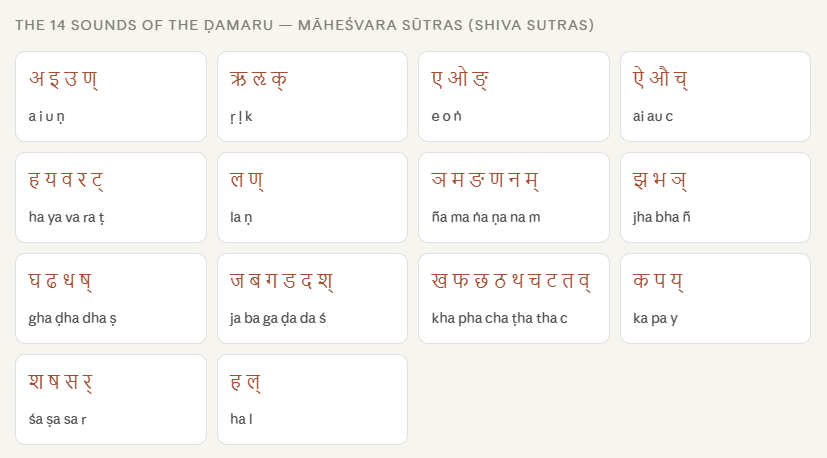
These fourteen phonemic groupings are not merely grammatical categories. They are the original vibrations of the Ḍamaru — the divine alphabet that underlies all of Sanskrit, which the Puranas describe as devabhāṣā, the language of the gods. Every Sanskrit mantra, every Vedic hymn, every shloka ever composed in praise of Shiva — all trace their ancestry to these fourteen beats of His drum. The Ḍamaru is the mother of all sacred language.
Nāda, Bindu, and the Mandukya Upanishad: The Sound Beyond Sound
The deepest meaning of the Ḍamaru lies not in its audible beat, but in what lies beneath it. Kashmir Shaivism — the most philosophically refined expression of Shaiva thought — teaches that behind the Ḍamaru’s sound is the Anāhata Nāda, the “unstruck sound.” This is the vibration that exists without any two things striking each other — the primordial hum of pure consciousness itself.
The Māṇḍūkya Upanishad establishes Oṃkāra as the sound of Brahman — all of past, present, and future, and that which transcends time. The Shaiva tradition identifies the Ḍamaru as the instrument of this very Oṃkāra. Each beat produces what the texts call Śabda Brahman — God in the form of sound. The Ḍamaru’s rhythm is therefore not a human-made music but a theophany — a direct manifestation of the divine.
“The sound of the drum invites the individual souls to His feet. It represents Omkāra. All Sanskrit alphabets have come out of the play of the Ḍamaru. There is vibration of Śabda Brahman. There is manifestation of primal energy. This is the dance of Shiva.”
— Commentary on Natarāja iconography, rooted in the Shaiva Āgamas and Shiva Purana
The Rhythm of Time: Faster Beats, Slower Beats
The Shaiva tradition also encodes the three Guṇas within the Ḍamaru’s rhythm itself. Faster beats of the drum correspond to Rajas — the quality of activity, energy, and creation. Slower beats correspond to Tamas — the quality of stillness, withdrawal, and dissolution. The balanced, steady rhythm between the two is Sattva — the quality of preservation and luminous clarity. The Ḍamaru does not merely accompany the Tandava; it is the Tandava — the cosmic pulse through which all three qualities of existence continuously arise and subside.
This is also why the Shiva Purana’s Vidyeśvara Saṃhitā speaks of the universe as cyclical — born, sustained, and dissolved in repeating ages. The Ḍamaru’s alternating beats are the heartbeat of that cycle. The two drumheads striking alternately — rising and falling — mirror the systole and diastole of the cosmic heart. As above, so below: your own heartbeat is a miniature Ḍamaru.
What This Means for the Devotee
The Shiva Purana, through Brahmā’s instruction to the sages in the Vidyeśvara Saṃhitā, teaches that listening — śravaṇa — is the very first step toward Shiva. What is the Ḍamaru if not the supreme invitation to śravaṇa? Shiva Himself is the first teacher of sound. When you hear the Ḍamaru, you are not hearing an instrument — you are hearing the universe being called into being, being called back home.
The next time you hear a Ḍamaru sound at a temple, in a bhajan, or in a stotra — close your eyes for a moment. Behind the audible beat, the Shiva Purana promises, the Anāhata Nāda vibrates always. That soundless sound is Shiva. And He is already, silently, the beat of your own heart.
Scriptural References
- Shiv Puran — Vidyeśvara Saṃhitā (Chs. 3–4: Śravaṇa as first path to Shiva); Rudra Saṃhitā (Natarāja iconography, Pañchakṛtya); Shiv Puran 2.3.27 (Ḍamaru described among Shiva’s attributes).
2. Linga Purana — Ch. 3 (achievement of sacred music; Nāda as creative principle); Chs. 6, 11 (Shiva as supreme, creative force permeating the Cosmic Egg).
3. Pāṇini’s Aṣṭādhyāyī — introductory verse (Nṛttavasāne Naṭarājo Nanāda Ḍhakkam…) on the Māheśvara Sūtras born from the 14 beats of the Ḍamaru.
4. Māṇḍūkya Upanishad — on Oṃkāra as Brahman, the sound of all time.
5. Vijñānabhairava Tantra (Kashmir Shaivism) — on Anāhata Nāda as the path to Shiva-consciousness.