
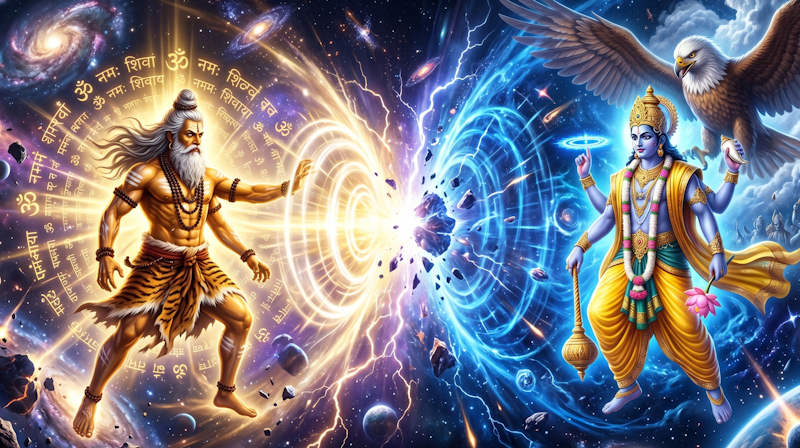
Where Vishnu’s Weapons Fell Silent — From the sacred pages of Shiv Purana Rudra Samhita
Introduction
What does it truly mean to surrender to Lord Shiva? Is it simply the lighting of incense, the pouring of milk over a Shivalinga, or the quiet murmur of mantras at dawn? Or does devotion to Mahadeva carry within it something more radical — something that transforms the very bones of a man, that makes the weapons of the gods fall useless, that causes Vishnu himself to stand speechless?
The Shiva Purana answers this question not through philosophy alone, but through story. And few stories in all of Hindu sacred literature are as dramatic, as theologically rich, and as deeply moving as the encounter between Sage Dadhichi and Lord Vishnu, preserved in the Rudra Samhita Section II of the Shiva Purana. In Shiv Puran Unlocked Part 1, this story is retold with all its original intensity, drawing from chapters thirty-eight and thirty-nine of the Sati narrative.
This is a story about what happens when a devotee of Shiva stands in the world. It is a story about the Mahamrityunjaya mantra, about adamantine bones and indestructible faith, about a sage who made the gods flee and Vishnu himself acknowledge defeat. At its heart, it is a story about the power of Shiva bhakti.
The Seeds of Conflict: A King’s Pride and a Brahmin’s Devotion
The story begins, as many great stories do, with a quarrel between friends.
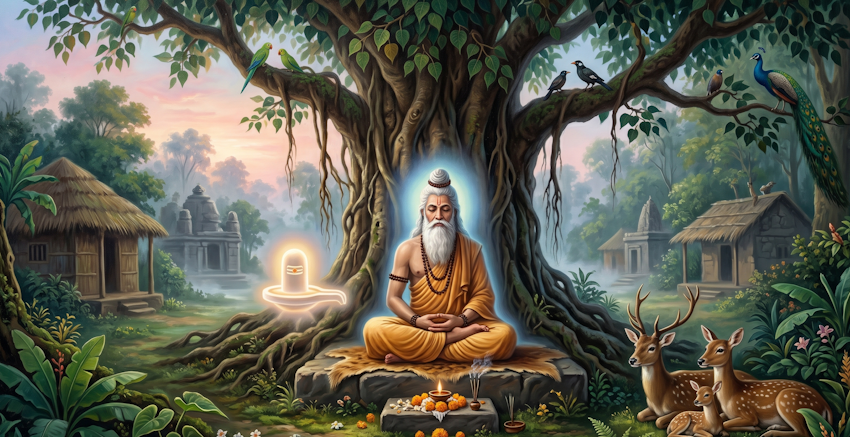
King Ksuva and Sage Dadhichi were companions. But the friendship cracked under the weight of ego. Ksuva, proud of his royal power, declared that kings are superior to brahmins, arguing that a king embodies the eight divine guardians of the world — he is, in his own estimation, practically a god walking the earth. Dadhichi, a devoted follower of Lord Shiva, could not accept this. He maintained that brahmins, those who carry the fire of sacred knowledge and who worship the Supreme, stand above all worldly power.
Words gave way to blows. Dadhichi struck Ksuva on the head. Ksuva retaliated with a thunderbolt.
This is where the story takes its first extraordinary turn.
The thunderbolt struck Dadhichi — and yet Dadhichi survived. He remembered his ancestor Sukra, one of the greatest sages and teachers known to the tradition, and through that remembered connection, through that lineage of sacred knowledge, he was protected.
Sukra, recognizing what had happened, did not simply offer comfort. He offered initiation. He taught Dadhichi the Mahamrityunjaya Mantra.
The Mahamrityunjaya Mantra: The Key That Opens Everything
Sukra’s teaching of the Mahamrityunjaya Mantra to Dadhichi is one of the most significant moments in these chapters, and Shiv Puran Unlocked Part 1 preserves its full theological weight.
Sukra explained to Dadhichi that the three-eyed Lord Shiva is the essence of everything — not a deity among deities, not a powerful god in a pantheon, but the very ground of existence itself. He instructed Dadhichi in the proper worship of Shiva through ritual, meditation, and inner surrender. He spoke of the form of Lord Shiva that must be held in the mind during meditation — the form that is simultaneously terrifying and tender, destroyer and protector, the one whose very name is liberation.
And then he delivered the teaching that changes everything: those who meditate in the presence of Shiva have no fear of death.
This is not metaphor. In the theology of the Shiva Purana, this is literal fact. The Mahamrityunjaya Mantra — Om Tryambakam Yajamahe Sugandhim Pushtivardhanam, Urvarukamiva Bandhanan Mrityor Mukshiya Maamritat — is the mantra that conquers death itself. It is addressed to the three-eyed Shiva, the one who sees what ordinary eyes cannot see, the one whose third eye perceives the eternal even within the temporal.
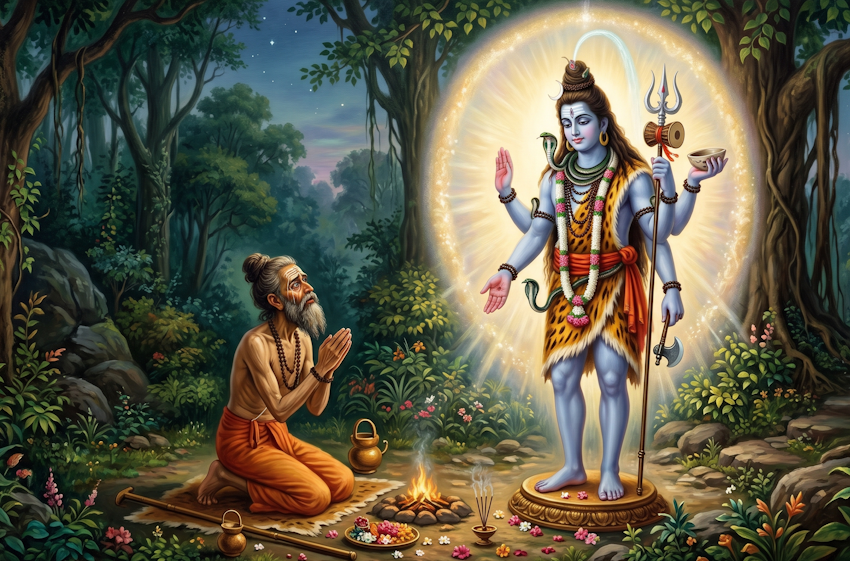
Dadhichi received this teaching not as information but as transformation. He took it into the forest, into silence, into years of severe penance. He repeated the mantra for a long, long time. And Shiva, pleased, appeared before him.
Three Boons and Bones of Diamond
When Shiva grants a boon, it is not a small gift. Lord Shiva, moved by the devotion of Dadhichi, offered him not one but three extraordinary gifts.
First, adamantine bones — bones as hard and indestructible as diamonds. This is significant beyond the merely physical. In the Shiva Purana’s symbolic vocabulary, the bones of Dadhichi would later become the weapon that destroys Vritra, the thunderbolt of Indra fashioned from the very skeleton of this devoted sage. His body, made sacred by devotion, would become an instrument of cosmic protection. But even before that future sacrifice, Shiva’s grace made Dadhichi’s physical form impenetrable.
Second, invincibility. No weapon, no army, no power in the three worlds could harm one upon whom Shiva had bestowed this protection.
Third, freedom from distress. Not merely happiness, but a state beyond the reach of sorrow entirely — the kind of unshakeable inner peace that belongs to those who have truly merged their consciousness with the divine.
Dadhichi, thus empowered, returned to the world. And when he encountered King Ksuva again, the reversal was complete — he kicked the king on the head with the sole of his foot. Ksuva tried once more to strike Dadhichi with his thunderbolt. It had no effect whatsoever. The king was defeated, not by brute force, but by the invincible grace of Mahadeva flowing through his devotee.
Lord Vishnu Enters the Picture
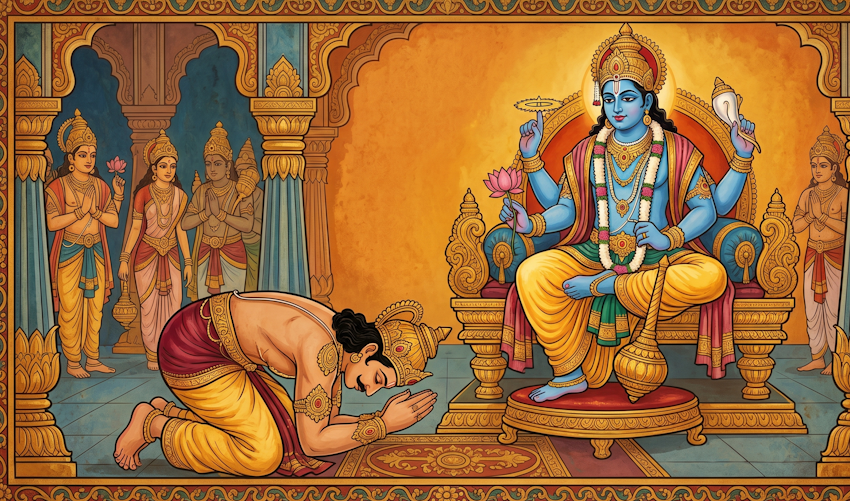
A humiliated king seeks a powerful ally. Ksuva turned to Lord Vishnu.
This is the moment that Shiv Puran Unlocked Part 1 draws from Rudra Samhita Section II, Chapter Thirty-Eight with particular care, because it addresses a question that might trouble a thoughtful reader: why would Vishnu, who knows the truth of Shiva’s supremacy, agree to help against a Shiva devotee?
Brahma’s answer to Narada is honest and layered. Vishnu was bound by a curse — the very curse that Dadhichi would later pronounce. He was also moved by Ksuva’s devotion and felt obligated to respond. But here is what is most remarkable: even as Vishnu agreed to help Ksuva, he acknowledged everything. He told Ksuva plainly that Shiva devotees are fearless. He admitted that he himself was destined to be destroyed at Daksha’s yagna by Shiva’s attendants, only to rise again later. He foretold that Daksha’s sacrifice would not be completed.
Vishnu knew the outcome before the battle even began. He went anyway — out of loyalty, out of the bondage of karma and curse, and perhaps out of a deeper divine play in which even apparent conflict serves the purposes of the Supreme.
The Confrontation: When Vishnu’s Discus Became Powerless
Chapter Thirty-Nine of the Rudra Samhita Section II describes one of the most extraordinary battles in the Shiva Purana — not a battle of equal forces, but a demonstration of what divine devotion does to the nature of power itself.
Vishnu came to Dadhichi’s hermitage in disguise, as a brahmin seeking a favor. It is a revealing choice — even Vishnu, knowing Dadhichi’s power, did not come openly at first. He came with strategy, with diplomacy, perhaps with the hope that the sage could be coaxed into a simple statement of fear that would satisfy Ksuva’s wounded pride.
Dadhichi saw through the disguise immediately.
This is the first demonstration of the transformative power of Shiva bhakti. The sage explained simply: through Shiva’s grace, he knows the past, present, and future. Everything is clear to him. He knows why Vishnu has come, whose errand he is running, and what is being asked. He told Vishnu to drop the pretense, reveal his true form, and remember Shiva.
Vishnu asked Dadhichi for just one concession — say once, for the sake of Vishnu and Ksuva, that you are afraid. Just once.
Dadhichi laughed.
He said he had no fear. Not because of his own power, but because of the power of Shiva. It was not the pride of a man inflated by his own strength. It was the fearlessness of one who has dissolved his ego into something larger than himself and therefore has nothing left to lose.
The Sudarshana Chakra That Could Not Work
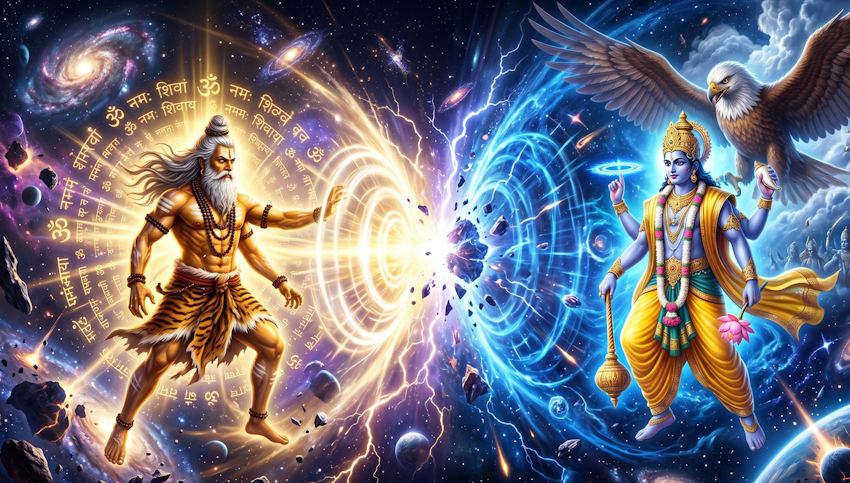
Vishnu, angered by Dadhichi’s laughter, revealed himself fully and raised the Sudarshana Chakra — his divine discus, one of the most powerful weapons in all creation, capable of ending worlds.
He hurled it at Dadhichi.
It became useless.
Dadhichi then delivered one of the most theologically significant lines in these chapters: the Sudarshana Chakra itself belongs to Shiva. It is Shiva’s discus. And therefore it cannot harm one who is protected by Shiva.
This is not merely a boast. In the theological framework of the Shiva Purana, all power ultimately flows from Shiva. Every weapon, every divine ability, every cosmic force — its source is Mahadeva. When a devotee is protected by Shiva, the weapons of even the greatest gods lose their potency because their power was borrowed from Shiva in the first place. You cannot use Shiva’s own energy against Shiva’s own devotee.
Dadhichi invited Vishnu to throw everything he had.
Vishnu did. He threw all his weapons. The assembled gods joined in, attacking Dadhichi with the full arsenal of heaven. And then Dadhichi did something extraordinary — he picked up a fistful of Kusha grass, the sacred grass used in Vedic rituals, and threw it.
Through Shiva’s grace, the Kusha grass transformed into tridents. Divine tridents that threatened to burn the gods. The weapons of the gods bowed before those tridents. The gods fled.
The Universe Within a Devotee
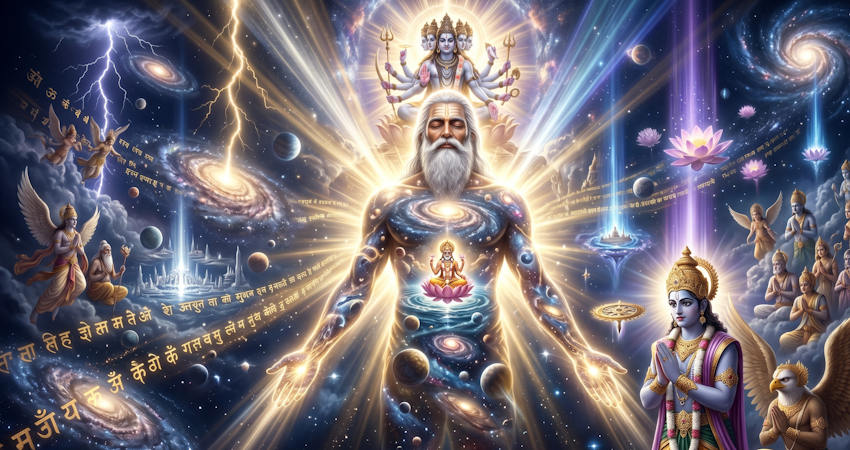
Vishnu, alone now, resorted to his power of cosmic illusion — the Maya that is his most profound tool. He showed Dadhichi a vision of the universe contained within Vishnu’s own body, a demonstration of divine omnipresence meant to overwhelm and awe.
Dadhichi was not overwhelmed.
He saw through the vision. And then he offered to show Vishnu something in return — the universe within himself, within the body of a Shiva devotee. When he revealed this vision, Vishnu saw within Dadhichi not just creation but Brahma, Rudra, and the entire cosmos. The devotee of Shiva carried the universe within himself because Shiva, who is the universe, dwelt within him.
At this point, Ksuva — the very king whose wounded ego had set all of this in motion — stepped forward and stopped the battle. He approached Dadhichi and asked for his blessing, and for Vishnu’s blessing too.
Dadhichi, furious, pronounced his curse: Vishnu and the gods would be burned by the anger of Rudra. He declared that brahmins must be honored by all. And then he returned to his hermitage in peace.
Sthaneshvara: Where the Sacred Battle Happened
The Shiva Purana records that the place where this extraordinary encounter occurred became sacred. It became known as Sthaneshvara — a place of pilgrimage where those who visit are freed from the cycle of rebirth and attain Sayujya with Shiva, the state of union with the divine.
Geography in Hindu sacred literature is never merely physical. When a place becomes the site of divine encounter, it absorbs that energy permanently. Sthaneshvara carries within it the vibration of Dadhichi’s fearlessness, of Vishnu’s humility, of the grace of Shiva that made a sage’s handful of grass more powerful than all the weapons of heaven.
Shiv Puran notes that the Shiva Purana promises those who read or listen to this story of the battle will be protected from premature death, and if they enter any battle, they will emerge victorious.
What This Story Teaches Us About Devotion
There are many lessons woven into these two chapters, but several rise to the surface with particular clarity.
The first is that Shiva bhakti is not a passive activity. Dadhichi did not achieve his extraordinary state by simply going through the motions of worship. He went into the forest. He performed severe penance. He repeated the Mahamrityunjaya Mantra for a long time. He surrendered completely, utterly, over an extended period of time. The grace that Shiva bestowed was proportional to the depth of Dadhichi’s commitment.
The second is that the protection of Shiva is total. It is not conditional on the external power of your opponent. Vishnu’s weapons, Vishnu’s illusions, the combined might of all the gods — none of it could touch someone wrapped in Shiva’s grace. This is not presented as rivalry between deities. It is presented as a theological truth: all power originates in Shiva, and therefore all power is helpless before those who have returned to Shiva.
The third is perhaps the most profound. Dadhichi’s fearlessness did not come from confidence in his own strength. It came from the dissolution of the self into Shiva. He said explicitly: he had no fear because of the power of Shiva — not his own power. The Mahamrityunjaya Mantra had done its work. It had freed him from the fear of death, and a man who does not fear death fears nothing at all.
The fourth lesson concerns Vishnu himself. His participation in this episode, fully knowing the outcome, knowing he would be defeated and cursed, is a teaching about karma and duty. And his eventual acknowledgment of Shiva’s supremacy — implicit in his inability to harm Dadhichi, explicit in the vision of the universe within the sage — is Vishnu’s own act of devotion, expressed through the medium of cosmic drama.
The Mahamrityunjaya Mantra: A Living Practice
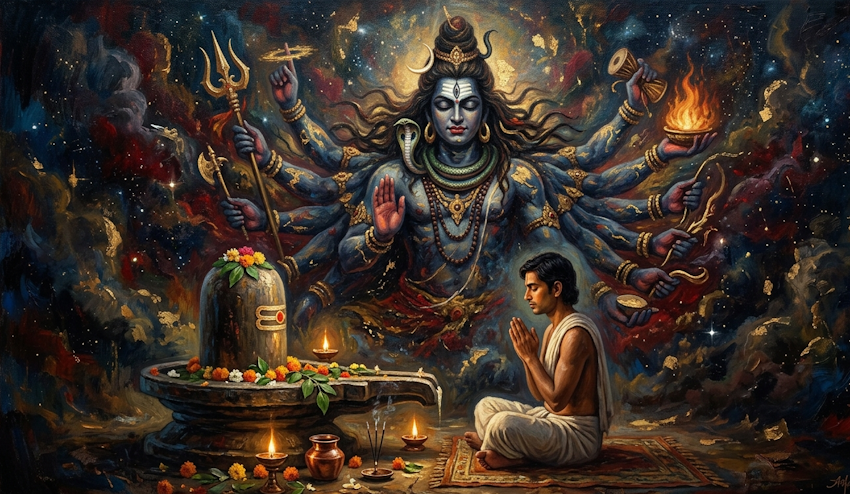
This story is also, at a practical level, an invitation. Sukra gave Dadhichi the Mahamrityunjaya Mantra not as a secret kept for the extraordinary, but as a living practice available to any sincere seeker. The mantra is among the most widely chanted in the Shaiva tradition precisely because its promise is universal — freedom from fear, protection from untimely death, union with the deathless consciousness that is Shiva.
Sukra’s instructions were clear: worship Shiva with devotion through rituals and meditation. Hold the form of Shiva in your mind. Meditate without ceasing. The form of Lord Shiva is not an abstraction — it is a specific, visualizable presence, radiating grace and protection, accessible to any mind willing to turn toward it.
Dadhichi’s story is proof that this practice works. Not as allegory. As lived reality.
Reference from Shiv Puran Unlocked Part 1
The story narrated in this blog is drawn from the Rudra Samhita Section II of the Shiva Purana, specifically Chapters Thirty-Eight and Thirty-Nine of the Sati narrative, as retold and explained in Shiv Puran Unlocked Part 1. Chapter Thirty-Eight covers the backstory of King Ksuva and Sage Dadhichi — the quarrel, the teaching of the Mahamrityunjaya Mantra by Sage Sukra, Shiva’s appearance and the granting of three boons, and Vishnu’s decision to help Ksuva despite knowing the outcome. Chapter Thirty-Nine narrates the confrontation itself — Vishnu’s disguised visit to Dadhichi’s hermitage, the battle, the failure of the Sudarshana Chakra, the transformation of Kusha grass into tridents, the vision of the universe within the devotee, and the curse pronounced by Dadhichi.
Shiv Puran Unlocked Part 1 presents this material with the original theological context intact, making visible what is often lost in simplified retellings — the deep logic of Shaiva theology that underlies every miraculous event in the narrative.
Conclusion: The Invincible Devotee
King Ksuva wanted to prove that kings are greater than brahmins. He ended up proving something no one expected: that a devotee of Shiva is greater than kings, greater than gods, greater even than the weapons of Vishnu.
Dadhichi did not set out to defeat Vishnu. He set out to worship Shiva. The defeat of Vishnu was simply a consequence — a side effect — of what happens when a human being surrenders completely to Mahadeva.
This is the supreme teaching of these chapters of the Shiva Purana. Devotion to Shiva does not merely comfort the devotee. It transforms them. It makes their bones diamond, their faith indestructible, their spirit unreachable by any force in any world.
The Mahamrityunjaya Mantra is not magic. It is not a trick. It is a doorway. What lies beyond the doorway is what Dadhichi found — and what every sincere seeker of Shiva can find — the fearless, deathless, luminous presence of Mahadeva himself.
Om Namah Shivaya.
A श्रद्धापूर्ण and meaningful writeup that reflects the greatness, peace, and supreme energy of Mahadev.