
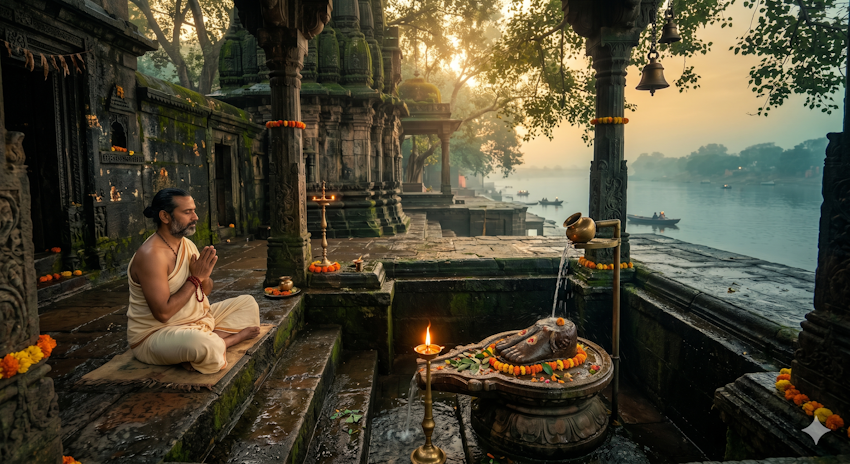
A story of devotion tested, faith discovered, and a miracle witnessed on the banks of the Dwarakeswar
There are moments in life when the veil between the visible and the invisible grows thin — when the Lord of Kailash, who is beyond all comprehension, stoops low enough to touch an ordinary household. This is one such story. It happened to people I know closely. And it changed everything.
A Household Divided by Devotion
Siddhartha was what you might call a man of the morning. Every day, before the city woke, before his wife Supriya had reached for her phone or thought about the day’s meetings, he was already at his altar — lighting incense, pouring water, murmuring the names of Mahadev with the unhurried steadiness of someone who had found the one thing that truly anchored him.
Supriya was different. Practical, sharp, deeply invested in her corporate career. She respected Siddhartha’s faith the way one respects a private habit — from a polite distance. But on rushed mornings, when they were already running late and Siddhartha showed no sign of finishing, the distance collapsed into frustration.
“How much longer? We’re going to miss the train again.”
Siddhartha would finish quietly, rinse his hands, and follow her out the door. But inside, there was something that never quite settled — a small ache, the feeling of having his most sacred hour interrupted, day after day. In those moments, he would whisper to Shiva with unusual tenderness:
“Hey Bholenath, give some wisdom to my wife. Let her understand what this is. And if you can — bring her to you.”
He prayed this not out of resentment, but out of longing. He wanted to share the most beautiful thing he had found, with the person he loved most. Shiva, of course, was listening. He simply had his own timeline.
The Trip to Bonolata
As the year wound down and the corporate world went quiet for its December shutdown, Siddhartha, Supriya, and her parents planned a short trip to Bonolata — a beloved resort in West Bengal, nestled amid vast green farmland. It is the kind of place that makes you exhale fully: orchards and vegetable gardens stretch in every direction, exotic birds call from the trees, and the air carries that rare combination of damp earth and ripening fruit. For a family that spends most of its year indoors under fluorescent light, Bonolata is a small paradise.
They enjoyed the first day thoroughly. The children of Kolkata and its satellite cities who visit such places always do — with the delight of people remembering that the world is larger than their screens.
But Siddhartha had something else on his mind.
The Adamant Devotee and the Temple of One Leg
It is well known among those who travel with devout Shaivas that any journey — however “leisure” in intent — will detour through at least one temple. Siddhartha had already identified his destination: Ekteshwar Mahadev, on the scenic banks of the Dwarakeswar River in Bankura.
The family resisted, as families always do. Too far. Too out of the way. Why not just rest? But Siddhartha, with the quiet persistence of a man who knows what he needs, prevailed. The next morning they set out.
The route itself was a blessing — winding through remote villages where life still moves at the pace of seasons, through mustard fields and clay-roofed homes, through the kind of silence that cities have forgotten. When they finally arrived at the temple, something shifted in the group. The noise inside each of them — the complaints, the reluctance — went still.
The temple of Ekteshwar Mahadev is not merely old. It is primordial in feeling. Local legend holds that when the kingdoms of Mallabhum (Bishnupur) and Samantabhum fell into bitter conflict over their shared border, Lord Shiva himself is said to have descended and sat in meditation at the disputed site — thereby resolving the dispute with his divine presence alone. The temple was built at exactly that spot. It was not established by a king or a merchant. It was established by Mahadev’s own stillness.
What makes the temple even more remarkable is its Shivalingam. The renowned scholar Acharya Jogeshchandra Roy cites Vedic references to a deity called Eka Padeshwar — “the one-footed Shiva.” At Ekteshwar, the Shivalingam is shaped like a foot, resting at the base of a deep, seven-foot well within the sanctum. To peer down into that well and behold that form is to feel something old and wordless stir in the chest.
Everyone in Siddhartha’s family felt it. Even those who had come reluctantly. Even Supriya.
They returned to Bonolata that evening quieter than they had left. The kind of quiet that is not emptiness but fullness.
The Fall
That night was their last at the resort. The next morning they would check out, pack the car, and head home. Supriya’s father — a gentle, dignified man — went to the cash counter to settle the bills.
He never made it.
There was an obstacle on the path. A slight misstep. His foot slipped, and what followed was the particular horror of a fall that happens too fast to stop — he went forward, face-first, and the impact was severe. Blood came immediately, from his nose, from inside his mouth. The sound that came from him was enough to bring Siddhartha and Supriya running.
They got him to the nearest hospital in the remote town. The doctors were dedicated but under-resourced. For nearly twenty minutes they struggled to stem the bleeding. When it finally stopped, X-rays were taken — and the concern was immediate: possible facial fracture. The bones of the face around the impact site had absorbed a force that, at his age, almost certainly meant surgical intervention.
They made a decision: leave at dawn for Kolkata.
It was a long, painful night.
The Weight of “What If”
Back in Kolkata, the consultations began. Doctor after doctor reviewed the X-rays and landed on the same conclusion: facial surgery was necessary. The fracture, if left untreated, would cause the bones to begin fusing incorrectly, eventually obstructing the movement of his jaw until he could no longer open his mouth normally.
Supriya held herself together during the day — scheduling appointments, coordinating with relatives, playing the role of the composed, capable daughter. But underneath it all was a terror she could not name, because naming it would make it real.
Finally they secured an appointment with a surgeon of exceptional experience — thirty years of facial reconstruction work, a reputation that preceded him, a schedule so full that most patients waited months.
The night before that appointment, something in Supriya broke open.
She came to Siddhartha. Not with the composure she had been performing all week. With tears, with desperation, with the kind of rawness that strips away every layer of pride and habit.
“Will your God help my father? Can He really help? Please, Siddhartha — tell me.”
And here is where the story becomes something more than a medical drama.
Siddhartha looked at his wife — the woman who had scolded him a hundred mornings for taking too long at his altar — and he smiled. Not condescendingly. Not with triumph. With the simple warmth of a man who has known the answer for a long time and has only been waiting for the other person to ask the question.
“Of course He will,” Siddhartha said. “If you come to Shiva with complete surrender — without conditions, without bargaining, just open hands and an open heart — He responds. Always. He doesn’t examine your past. He doesn’t judge your doubts. He simply responds to sincerity.”
He gave Supriya specific instructions, the way Shiva’s grace often works — through small, tender acts of devotion:
Take clean water, mix it with Gangajal, and offer it on the Shivalingam at home while saying: “Hey Kundkeshwar Bhagwan, I am offering this water to you. Please heal my father. Let this operation not be necessary.” Then let her father drink a little of that water — the prasadam of the lingam itself. Take Bilva leaves, place them on the lingam, pour water over them, and then gently touch that Shivalingam to the place on her father’s face that had been injured.
Supriya, who had spent years being mildly exasperated by this very altar, knelt before it that night and did exactly what she had been told.
This was also, Siddhartha would later admit, a profound test of his own faith. He had made a promise on behalf of his Lord. He had staked his certainty on Mahadev’s compassion. There was no hedging. Now he could only wait.
One Hour of a Thousand Minutes
The next morning, Siddhartha drove his wife and father-in-law to the surgeon’s clinic. He did not go inside. He sat in the car.
For the next hour, he recited the names of Shiva continuously — not in the comfortable, rhythmic way of daily practice, but with the concentrated urgency of someone who is holding something precious and fragile.
Hey Mahadev. Hey Bhole. Hey Shankar. Please.
He said later that each minute felt like an hour. That the parking lot outside a doctor’s clinic is one of the loneliest places in the world.
And then the door opened. Supriya and her father walked out.
They were smiling.
The Surgeon’s Confusion
Inside, the doctor had conducted his examination with the thoroughness that thirty years of experience produces. He reviewed all the imaging. He asked the father to open his mouth as wide as he could and pressed a small probe gently against the site of the injury.
Then he went quiet.
Supriya, nervous in the silence, began telling the story of the accident — the resort, the fall, the remote hospital, the long drive home. The doctor listened. Then he set his instruments down.
“His jaw is opening normally,” he said. “Mechanically, there is no obstruction. Based on everything in front of me — the reports, the imaging, my examination — I do not believe surgery is necessary.”
He paused.
“You know, ninety percent of the cases I see result in surgical recommendations. That is the nature of this work. But something about his situation — his age, the specific nature of the injury, something I cannot quite account for — is telling me that conservative treatment is the right approach. Some medication, some rest, a follow-up in three weeks.”
And then — this is the part that Supriya still cannot narrate without her voice catching — the doctor’s expression changed.
He looked at her father. He looked at Supriya. And quietly, almost to himself, he said:
“I don’t fully understand why I am saying this. I am someone who almost always recommends surgery in cases like this. But today, I am not. I simply… am not.”
What Happened in the Car
When Supriya told Siddhartha what had transpired, she did not speak for a long moment after she finished. Then she turned to him.
“Please forgive me,” she said. “I have always believed that miracles don’t happen. That these things are superstition, or wishful thinking, or the kind of story people tell to comfort themselves. But I understand now. Lord Shiva is real. He is here. He is compassionate beyond anything I imagined.”
She made a vow, quietly and with the whole weight of her changed heart behind it:
“Every Monday, I will prepare offerings and prasadam with complete devotion. And I will never — not once — scold you during your puja again.”
What This Story Teaches
Siddhartha had prayed for one thing, every morning, for years: that his wife would find her way to Shiva. Not to satisfy his ego. Not to win an argument. But because he had found in Shiva something so beautiful — so steady, so boundless — that he could not bear for the person he loved most to go through life without knowing it.
Shiva answered that prayer. But not in the way Siddhartha expected. Not through a lecture, or a conversation, or a moment of gentle persuasion. He answered it by placing a crisis in the middle of their lives and then dissolving it — so completely, so undeniably, that even a scientific, corporate-minded woman found herself on her knees before a Shivalingam, her certainties quietly rearranged.
This is how Bholenath works. He does not argue. He does not debate. He simply waits — patient as the mountain He sits upon — until the soul is ready. And then He acts.
The journey to Ekteshwar Mahadev was not accidental. The fall at the resort was not random misfortune. The surgeon’s inexplicable change of heart was not a coincidence. When you trace the thread backward, you find it leads to a man who stood at his altar every morning and whispered:
“Hey Bholenath, give some wisdom to my wife.”
A Note on Ekteshwar Mahadev
If this story moves you and you find yourself drawn to visit, Ekteshwar Mahadev temple is located on the banks of the Dwarakeswar River in Bankura, West Bengal. The Shivalingam in the shape of a foot, resting in its seven-foot well, is unlike almost anything you will encounter in your travels through Shiva’s sacred geography. The environment on the banks of the river is serene and ancient in feel — the kind of place where prayer rises more easily than usual.
Make time for it. You may not know, yet, what you are going to find there.
Om Namah Shivaya.
Har Har Mahadev.
This account is based on a real incident from the life of a close relative of the author. Names have been used with the family’s permission and blessing. The author does not claim to explain the inexplicable — only to bear witness to what happened.