
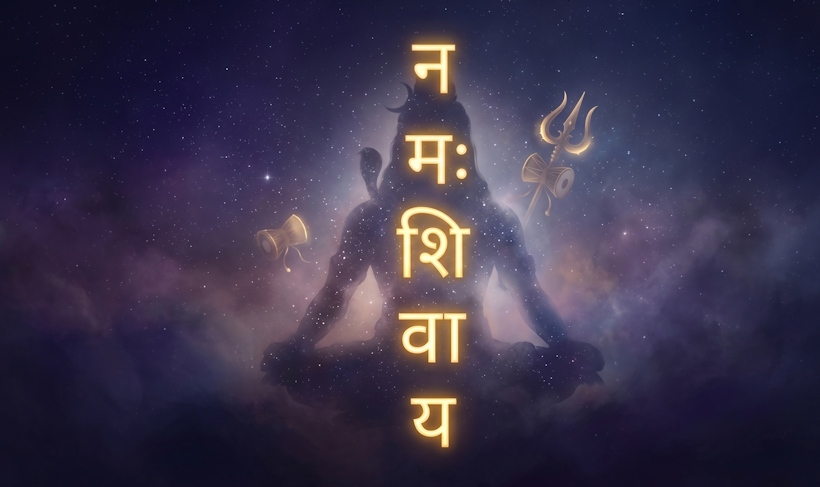
शिव पञ्चाक्षर स्तोत्रम्
“Namaḥ Śivāya” — Salutation to Śiva, the Auspicious One
There is a prayer so ancient, so condensed, so luminous that the great Ādi Śaṅkarācārya — the philosopher who unified the four corners of India with his feet and the entire cosmos with his pen — chose to compose an entire stotram around it. That prayer is the Pañchākṣara Stotram: Namaḥ Śivāya — five syllables that, according to the Śiva Purāṇa, contain within them the thirty-six tattvas, the five great elements, the entire created universe, and liberation itself.
The Śiva Pañchākṣara Stotram is composed of five verses — one for each of the sacred syllables Na, Ma, Śi, Vā, Ya. Each verse begins with its corresponding syllable, celebrates one aspect of Lord Śiva associated with that letter, and builds into a devotional crescendo. A sixth concluding verse (the phalaśruti) describes the merit of reciting the stotram. Written in flawless metre, the stotram is simultaneously a poem, a philosophical treatise, and a mantra in expanded form.
This blog takes you through every verse — its Sanskrit, transliteration, translation, word-by-word meaning, and the deep spiritual significance hidden within.
Before We Begin: Understanding the Pañcākṣara
In the Kṛṣṇa Yajurveda’s Śrī Rudram, the eighth anuvāka contains the line “namaḥ śivāya cha śivatarāya cha” — from which the five-syllable core mantra was extracted. By the time of the Śiva Purāṇa, this mantra had become the supreme Śaiva mantra, called the Pañcākṣarī — the five-lettered one.
Each syllable maps to one of the Pañca Bhūtas — the five great elements:
न (Na) — Pṛthvī (Earth) — the foundation, the grounded reality म (Ma) — Jala (Water) — the life-force, the flow that sustains शि (Śi) — Agni (Fire) — the transformative light of consciousness वा (Vā) — Vāyu (Air) — the breath, prāṇa, movement of grace य (Ya) — Ākāśa (Space/Ether) — the infinite, the pure sky of awareness
Śhaṅkarāchārya, composing in the 8th century CE, took each of these syllables and dedicated an entire verse to it — each verse celebrating a particular form or quality of Śiva associated with that element and letter. The result is this stotram: compact, musical, theologically rich, and inexhaustibly deep.
Verse I — The Syllable NA (नकाराय)
Sanskrit: नागेन्द्रहाराय त्रिलोचनाय भस्माङ्गरागाय महेश्वराय। नित्याय शुद्धाय दिगम्बराय तस्मै नकाराय नमः शिवाय॥
Transliteration: Nāgendrahārāya trilocanāya Bhasmāṅgarāgāya maheśvarāya | Nityāya śuddhāya digambarāya Tasmai nakārāya namaḥ śivāya ||
Translation: “To the one who wears the king of serpents as a garland, who has three eyes, who is adorned with ash smeared across his body, who is the great Lord — to the eternal, the pure, the one clad in the directions themselves — to that Śiva who is the syllable ‘Na’, I bow.”
Word-by-Word Meaning:
Nāgendrahārāya — Nāga (serpent) + Indra (king) + Hāra (garland) — He who wears Vāsuki, king of all serpents, as a garland around his neck.
Trilocanāya — Tri (three) + Locana (eyes) — The three-eyed one. His third eye is the eye of jñāna, the wisdom that burns ignorance to ash.
Bhasmāṅgarāgāya — Bhasma (sacred ash) + Aṅga (body) + Rāga (adornment) — He whose entire body is smeared with ash from the cremation ground.
Maheśvarāya — Mahā (great) + Īśvara (lord) — The supreme lord of the universe.
Nityāya — Eternal, beyond time, without beginning or end.
Śuddhāya — Pure, beyond all taint, untouched by māyā.
Digambarāya — Dik (directions/sky) + Ambara (garment) — Clothed in the sky itself; the naked Ascetic whose garment is the infinite.
Deeper Meaning:
The first verse opens with four powerful epithets strung together like prayer beads, each one a universe of meaning.
The serpent garland is not mere ornament. The serpent in Śaiva symbolism represents kāla (time) and kuṇḍalinī (dormant cosmic energy). Śiva wears time itself as decoration — he is not bound by it, he plays with it.
The bhasma or sacred ash speaks to the ultimate philosophical truth: everything returns to ash. Śiva, ever present at the cremation ground (śmaśāna), smears the ash of the burned universe on his body as a statement — I am that which remains after all else is consumed.
Digambara — clothed in sky — is the most radical image. The infinite cannot be clothed. Śiva’s nakedness is not poverty but completeness: he who owns all directions needs no other covering.
This first syllable Na corresponds to Earth. Like the earth, Śiva is the foundation — eternal, solid, bearing all creation upon himself, unchanged beneath all change.
Verse II — The Syllable MA (मकाराय)
Sanskrit: मन्दाकिनीसलिलचन्दनचर्चिताय नन्दीश्वरप्रमथनाथमहेश्वराय। मन्दारपुष्पबहुपुष्पसुपूजिताय तस्मै मकाराय नमः शिवाय॥
Transliteration: Mandākinīsalilacandanacarcitāya Nandīśvarapramathanāthamaheśvarāya | Mandārapuṣpabahupuṣpasupūjitāya Tasmai makārāya namaḥ śivāya ||
Translation: “To the one anointed with the waters of Mandākinī and sandalwood paste, who is the lord of Nandīśvara and the host of Pramathas, the great God — who is worshipped with Mandāra flowers and many auspicious blossoms — to that Śiva who is the syllable ‘Ma’, I bow.”
Word-by-Word Meaning:
Mandākinī — The celestial Gaṅgā — the river of heaven, flowing from Śiva’s matted locks. Mandākinī is its name in heaven; Bhāgīrathī on earth.
Salila — Water, sacred water — the living, flowing element.
Candana — Sandalwood paste — one of the sixteen upacāras (offerings) in pūjā; cooling, fragrant, a mark of divine welcome.
Carcitāya — Smeared, anointed — he upon whom devotion is expressed through physical touch.
Nandīśvara — Lord of Nandī — Nandī the divine bull, the gate-guardian of Kailāsa, the embodiment of joyful devotion.
Pramathanātha — Lord of the Pramathas — Śiva’s ecstatic attendants, the gaṇas who dance and revel in his presence.
Mandāra — The divine coral tree of Svarga — one of the five heavenly trees, used in Śiva pūjā for its beauty.
Deeper Meaning:
This verse is saturated with water imagery. The syllable Ma governs Jala (Water), the element of life, nourishment, and devotion itself.
Here Śiva is presented not as the fierce ascetic but as the centre of worship — bathed in the waters of heaven, anointed with sandal paste, garlanded with flowers by the gods themselves.
The mention of Nandī is deeply significant. Nandī is not merely a vehicle (vāhana) — Nandī is the living principle of ānanda (bliss). The name itself means joy. Śiva’s vehicle is bliss itself. Wherever Śiva moves, joy moves with him.
The Pramathas — Śiva’s wild, ecstatic retinue — represent liberated souls. They have gone beyond propriety, beyond fear, into the pure joy of being in Śiva’s presence. To be the lord of such beings is to be the lord of liberation.
Verse III — The Syllable ŚI (शिकाराय)
Sanskrit: शिवाय गौरीवदनाब्जवृन्द- सूर्याय दक्षाध्वरनाशकाय। श्रीनीलकण्ठाय वृषध्वजाय तस्मै शिकाराय नमः शिवाय॥
Transliteration: Śivāya gaurīvadanābjavṛnda- Sūryāya dakṣādhvaranāśakāya | Śrīnīlakaṇṭhāya vṛṣadhvajāya Tasmai śikārāya namaḥ śivāya ||
Translation: “To the auspicious one, who is the sun to the lotus-face of Gaurī, who is the destroyer of Dakṣa’s sacrifice — to the blue-throated one, to the one whose banner bears a bull — to that Śiva who is the syllable ‘Śi’, I bow.”
Word-by-Word Meaning:
Śivāya — To the auspicious one. The name Śiva itself means auspiciousness, well-being, that which blesses.
Gaurī-vadana-abja-vṛnda-Sūryāya — He who is like the sun to the lotus-cluster of Gaurī’s face. The lotus blooms only in the presence of the sun. Pārvatī blooms only in the presence of Śiva.
Dakṣādhvara-nāśakāya — Dakṣa + Adhvara (yajña) + Nāśaka (destroyer) — He who destroyed Dakṣa’s arrogant sacrifice.
Śrī Nīlakaṇṭhāya — Nīla (blue) + Kaṇṭha (throat) — The blue-throated one, who swallowed the cosmic poison Hālāhala at the churning of the ocean.
Vṛṣadhvajāya — Vṛṣa (bull/dharma) + Dhvaja (banner) — He whose flag bears the bull, the emblem of dharma.
Deeper Meaning:
Here Śaṅkara reveals Śiva through two of his most beloved and dramatic mythic roles — the devoted husband and the righteous destroyer. The syllable Śi governs Agni (Fire) — and fire both illuminates and consumes.
The image of Śiva as the sun to Gaurī’s lotus-face is extraordinarily tender. This is the Ardhānārīśvara principle in poetic form: they complete each other. Without Śiva, Śakti has no awareness; without Śakti, Śiva has no manifestation.
The destruction of Dakṣa’s yajña is one of Śaivism’s great theological events. Dakṣa did not invite Śiva to his grand sacrifice — an act of insult so profound that Satī, Śiva’s wife, immolated herself in protest. What followed was Śiva’s grief-turned-wrath: Vīrabhadra rose from his matted locks and the arrogant yajña was annihilated. The lesson is clear: no ritual, however elaborate, has value without the grace of Śiva.
And then — Nīlakaṇṭha. When the gods and demons churned the cosmic ocean, what arose first was Hālāhala — the world-destroying poison. All the gods fled. Śiva alone stepped forward and swallowed it. Pārvatī caught his throat in her hands to prevent it reaching his stomach — and the poison turned his throat blue forever. He wears that blue throat as a badge of selfless, total love for creation. The Nīlakaṇṭha did not seek credit. He simply saved.
The poison of the world did not destroy him — it adorned him. The blue throat is not a wound. It is the mark of the one who swallowed suffering so others need not.
Verse IV — The Syllable VĀ (वकाराय)
Sanskrit: वसिष्ठकुम्भोद्भवगौतमार्य- मुनीन्द्रदेवार्चितशेखराय। चन्द्रार्कवैश्वानरलोचनाय तस्मै वकाराय नमः शिवाय॥
Transliteration: Vasiṣṭhakumbhodbhavagautamārya- Munīndradevārcitaśekharāya | Candrārkavaiśvānaralocanāya Tasmai vakārāya namaḥ śivāya ||
Translation: “To the one whose crown is worshipped by the foremost of sages — Vasiṣṭha, Agastya, Gautama and other great ones — and by the gods themselves, whose three eyes are the moon, the sun, and fire — to that Śiva who is the syllable ‘Vā’, I bow.”
Word-by-Word Meaning:
Vasiṣṭha — The great ṛṣi of the Saptarṣis, mind-born son of Brahmā, guru of the solar dynasty including Rāma himself.
Kumbhodbhava — Born from a pot — the epithet of the sage Agastya, who was born from a clay pot.
Gautama — The great Vedic sage, one of the Saptarṣis, husband of Ahalyā.
Munīndra-devārcita-śekharāya — He whose crown is bowed to by the greatest sages and by the gods themselves.
Candra — The moon — his left eye; governs the mind, the night, intuition, the cooling light.
Arka — The sun — his right eye; governs vitality, the day, clarity, the revealing light.
Vaiśvānara — Fire — his third eye; the universal fire, Agni as transcendent consciousness.
Deeper Meaning:
The roll call of great sages — Vasiṣṭha, Agastya, Gautama — establishes a crucial point: Śiva is not merely one deity among the pantheon. He is the source that the greatest knowers themselves approach with reverence. He is worshipped even by those who teach worship.
The three-eyed cosmology is here decoded completely:
The moon is his left eye — the eye of soma, cool perception, the night-mind, dreams and intuition. The sun is his right eye — the eye of solar logic, clarity, the revealing day-consciousness. The fire is his third eye — the transcendent eye of wisdom that goes beyond the dualities of day and night, manifest and unmanifest.
Together, Śiva’s three eyes encompass all possible forms of perception — and still, he sees beyond all of them.
Vāyu — breath — is the most intimate of the elements. With every breath, you receive Śiva’s presence. The Vā syllable is the breath of the mantra itself.
Verse V — The Syllable YA (यकाराय)
Sanskrit: यज्ञस्वरूपाय जटाधराय पिनाकहस्ताय सनातनाय। दिव्याय देवाय दिगम्बराय तस्मै यकाराय नमः शिवाय॥
Transliteration: Yajñasvarūpāya jaṭādharāya Pinākahasrāya sanātanāya | Divyāya devāya digambarāya Tasmai yakārāya namaḥ śivāya ||
Translation: “To the one who is the very form of sacrifice, who bears matted locks, who holds the Pināka bow, the ancient and eternal one — to the divine, to the resplendent God, to the one clad in the sky — to that Śiva who is the syllable ‘Ya’, I bow.”
Word-by-Word Meaning:
Yajña-svarūpāya — Yajña (sacrifice) + Svarūpa (essential nature) — He whose very nature is sacrifice; not the receiver of yajña but yajña itself.
Jaṭādharāya — He who bears matted locks; the mark of the ascetic who has renounced all worldly grooming.
Pināka-hastāya — He who holds the Pināka in his hand — Śiva’s divine bow, so powerful that Rāma’s breaking of it at Sītā’s svayaṃvara announced him as a worthy warrior of cosmic stature.
Sanātanāya — The primordial, the beginningless, the one who exists beyond all origins.
Divyāya — Divine, luminous, belonging to the realm of the shining ones.
Devāya — From the root div, to shine — the luminous God himself.
Digambarāya — Clothed in the sky; the infinite nakedness of the Absolute. This epithet appears in both Verse 1 and Verse 5 — a deliberate structural echo by Śaṅkara.
Deeper Meaning:
The fifth syllable Ya corresponds to Ākāśa — space, the infinite ether that contains all other elements and is contained by none. The verse accordingly soars.
Yajña-svarūpa — the form of sacrifice — is the verse’s most philosophically radical claim. The Bhagavad Gītā tells us: ahaṃ kratur aham yajñaḥ — “I am the ritual, I am the sacrifice.” Here Śiva is identified with that ultimate principle: he is not worshipped through yajña — he is the yajña. Every act of giving, every oblation into fire, every surrender of ego is Śiva expressing himself.
The Pināka bow is Śiva’s weapon of dharmic testing — so mighty that no ordinary warrior could string it. When Rāma effortlessly strung and broke it, Paraśurāma recognized this as divine power. The Pināka reveals who is truly worthy.
Digambara appears for the second time — in both Verse 1 and Verse 5 — as a deliberate echo. The stotram opens and closes with the sky-clothed infinite. In between are the serpents, the ash, the water, the devotees, the sages, the moon and sun. All of it contained within the one who needs no garment but the infinite.
The Phalaśruti — The Fruit of Recitation
Sanskrit: पञ्चाक्षरमिदं पुण्यं यः पठेच्छिवसन्निधौ। शिवलोकमवाप्नोति शिवेन सह मोदते॥
Transliteration: Pañcākṣaramidaṃ puṇyaṃ yaḥ paṭhecchivasannidhau | Śivalokamavāpnoti śivena saha modate ||
Translation: “Whoever recites this holy Pañcākṣara in the presence of Śiva — attains the realm of Śiva and rejoices together with Śiva.”
Word-by-Word Meaning:
Pañcākṣaram idam puṇyam — This five-syllabled holy text, generating sacred merit.
Yaḥ paṭhet — Whoever recites — the fruit is available to all who engage sincerely.
Śiva-sannidhau — In the presence of Śiva — in a temple, in meditation, in the inner space of Śiva-awareness.
Śivalokam avāpnoti — Attains Śivaloka — the realm of Śiva, Kailāsa, the state of liberation in his proximity.
Śivena saha modate — Rejoices with Śiva — the intimacy of sāyujya mukti, the joy of union with the divine.
Deeper Meaning:
The word modate — “rejoices” — is the stotram’s final and most beautiful gift. Liberation here is not the cold extinction of consciousness. It is joy. The devotee does not merely reach Śiva’s realm — he rejoices with Śiva. This reflects the Śaiva Siddhānta understanding of mukti: the individual soul retains its identity even in liberation, and experiences the bliss of Śiva’s presence eternally.
The condition śiva-sannidhau — in Śiva’s presence — is not merely spatial (before a Śivaliṅga). It is a state of consciousness. To recite this stotram with awareness and devotion is to be in Śiva’s presence. The temple is not just stone — it is the interior space of the devotee’s own heart.
Why This Stotram Endures
The Śiva Pañcākṣara Stotram has been recited for over twelve centuries — in granite temples, in forest hermitages, in the pre-dawn darkness before a domestic altar, in the mind of a dying man seeking peace.
Structurally, it is a masterpiece of compression. Each verse contains several independent images of Śiva, yet they cohere into a single portrait. Read all five verses together and what emerges is not a list of attributes but a living presence — the ash-smeared ascetic who is also the devoted husband, who is also the cosmic saviour, who is also the eternal sacrifice, who is also the infinite sky.
Theologically, it maps the mantra’s five syllables onto the five elements, the five senses, the five kośas — the entire architecture of Vedic and Tantric cosmology is implicit in its five short verses. A scholar can spend a lifetime unpacking it; a child can sing it at dawn.
And spiritually — it is a sādhana in itself. To recite it daily is to learn, by repetition, to see Śiva everywhere: in the earth beneath your feet (Na), in the water you drink (Ma), in the fire in your belly (Śi), in the breath in your lungs (Vā), in the space of your own awareness (Ya).
The mantra is not asking you to believe in an external deity. It is pointing, insistently, to the recognition that Namaḥ Śivāya — the one to whom we bow — is also the one doing the bowing, and also the bowing itself.
A Note on Daily Practice
The stotram is traditionally recited:
At the time of abhiṣeka — the ritual bathing of the Śivaliṅga, in resonance with “Mandākinī-salila-candana-carcitāya.”
During Pradoṣa Vrata — the fortnightly evening worship, especially potent in Śiva bhakti.
On Mahāśivarātrī — the great night of Śiva, when its continuous recitation through the four watches of the night is considered supremely meritorious.
As a morning stotram — five verses, five syllables, five minutes — setting the tone of the entire day in Śiva’s awareness.
One need not memorise complex Sanskrit grammar on the first reading. One need not understand every epithet immediately. The tradition’s wisdom is simply: begin. Recite. Let the syllables work on you. Namaḥ Śivāya is its own teacher.
The Pañcākṣara Stotram is attributed to Ādi Śaṅkarācārya (788–820 CE), the great Advaita Vedāntin from Kāladi, Kerala, who composed hymns across the Śaiva, Śākta, and Vaiṣṇava traditions. It is found in his collected works as a core text of Śaiva devotion and philosophical instruction.
ॐ नमः शिवाय Har Har Mahadev