
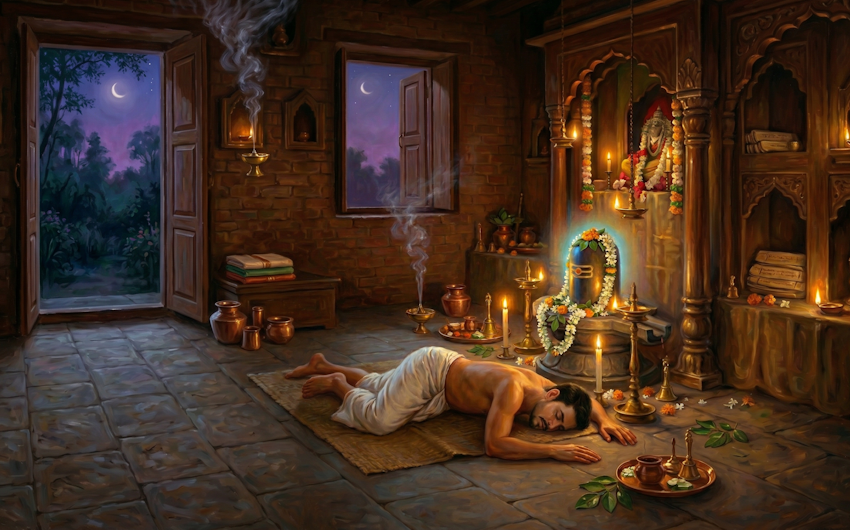
A True Story of Unconditional Devotion
The Altar Before Dawn
In a society flat in Howrah, West Bengal, before the city stirred and before his son Prasanna woke for school, a man named Siddhartha stood before his Shivalinga.
Every morning it was the same sacred sequence — jal abhisheka, the cool whisper of water meeting the linga; dhoop rising in curling grey spirals; the warm tongue of a deepam; fresh flowers laid with quiet reverence; and finally the morning arti, the lamp circling in slow orbits of devotion. Then Siddhartha would leave for his corporate office, carrying in his chest a stillness that no traffic, no deadline, no boardroom friction could entirely dissolve.
His wife Priya moved through those same mornings differently — efficiently. She was a woman of formidable capability, recently promoted to Head of India at her company, and mornings for her were a choreography of packed school bags, tiffin boxes, pressed clothes, and a son named Prasanna who needed to be delivered to school before she reached her own demanding chair. She did the puja when she could, which was rarely, and when she did it was more out of habit than hunger. She respected Siddhartha’s devotion. She simply did not share it. Not yet.
This is a story about what changed that.
The First Shadow
The attacks began subtly.
Priya’s promotion had made her visible — and visibility, in certain hearts, breeds resentment. An office colleague, quietly consumed by jealousy, had turned to darker means. What followed was not the language of offices and performance reviews. It was something far older.
On the return journey from a family wedding in Lucknow, Priya collapsed into a state that no rational framework could comfortably explain. High fever, searing ear pain, the inability to speak, total debilitation — and worse, visions. Things that moved at the edges of rooms when nothing should have been moving.
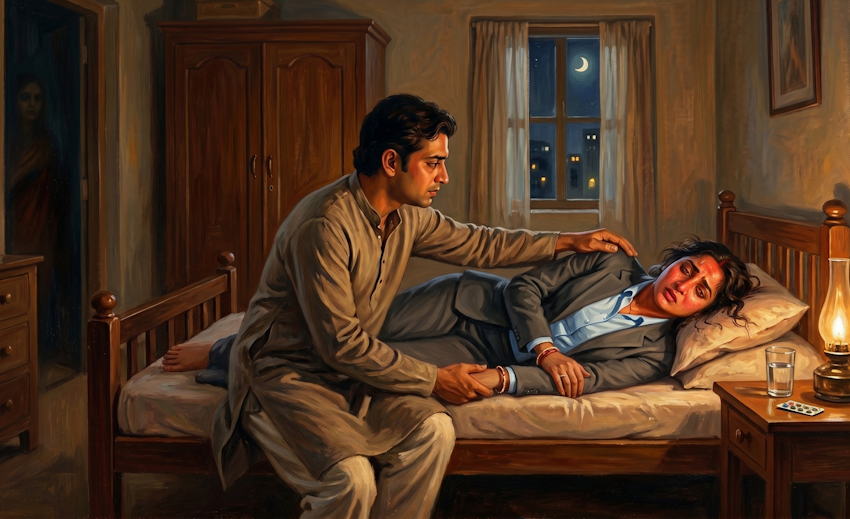
Siddhartha called his elder cousin Aman, a man who walked comfortably in the world of tantra and whose number he had saved after that same Lucknow wedding. Aman’s assessment was swift and unambiguous: someone had used Priya’s consumption of offered food and drink as a vehicle to send malevolent energy into her body. A sophisticated attack. A cruel one.
Aman prescribed specific kriyas for Siddhartha to perform. Within a single day — a single day — Priya was restored. Completely. As though nothing had happened. She sat up in bed, clear-eyed and bewildered, and for the first time in her life began to entertain the possibility that the invisible world was not, in fact, invisible.
The Attacks Multiply
But the colleague did not stop.
The assaults came in waves across the following weeks. Each time, Siddhartha’s vigilance and Aman’s guidance formed a wall. The attacks broke against it. Priya began keeping her own vigil now — not quite a devotee, but no longer a dismisser either. She had seen too much.
Then came the morning that changed everything.
Prasanna’s Pain
It started as what parents tell themselves is nothing.
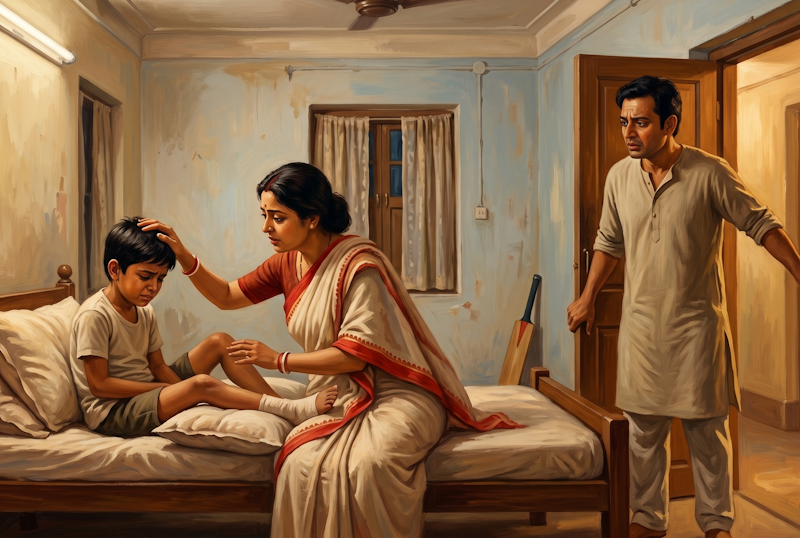
Eight-year-old Prasanna, who played cricket at the nearby stadium with the focused joy of a boy who doesn’t yet know what heartbreak is, began complaining of pain in his left ankle. Cricket strains. Growing pains. Warm water compress. Rest.
But the pain did not read the script of ordinary childhood injuries. It deepened. It spread. Pain killers offered four hours of relief, then the agony returned like a tide. One morning it escalated to something that made both parents go cold — Prasanna was screaming.
Aman confirmed what both feared: the tantric had pivoted. Unable to reach Priya through Siddhartha’s shield, he had turned his intent toward the child. And the force directed at Prasanna was not mild. Aman said it quietly but clearly: this was power drawn from Maa Tara. High-level. Fierce.
More kriyas. Temporary relief. Prasanna slept. For a few hours, the household breathed.
Monday Morning
It was a Monday, and Siddhartha had stayed home.
Priya had left for office. Prasanna had woken with reduced but present pain, enough that Siddhartha felt the wisdom of staying nearby. It was his usual day for milk abhisheka on the Shivalinga, and he had just begun his puja — the milk flowing over the sacred stone, the mantras rising to his lips — when Prasanna began screaming again.
This time it was worse than anything before.
Aman was called. His voice was strained. The tantric had attacked again, and with a ferocity that exceeded all previous attempts. “I am doing mantra japa,” he said. “Do not worry. It will be all right.” But this time, his certainty carried a weight it hadn’t before. Both men knew the enemy had escalated.
Siddhartha called his in-laws, who lived nearby. They arrived. They all went to the hospital together. When Priya received the call, she left her office and arrived at the hospital shortly after. The doctors examined Prasanna. X-rays were taken. The orthopedic’s verdict was almost surreal in its inadequacy: bone growth. Possibly causing some discomfort. Pain killers and calcium supplementation.
No doctor said: this child’s pain is beyond the reach of my instruments. But that, in essence, is what the X-rays said. Because there was nothing there. Nothing that should cause a boy to scream the way Prasanna had screamed.
They returned home. The afternoon was quiet. Then night came.
The Night No Medicine Could Reach
The pain that descended on Prasanna that night was of a different order entirely.
He could not walk. He could not place his foot on the bed. He held his leg elevated, suspended in air, because every contact with any surface sent agony through him. Siddhartha and Priya sat with him in rotating shifts of helplessness. Aman worked his rituals through the night but reported that something was resisting — something was holding.
Siddhartha’s father in Lucknow, a professor at a prestigious medical university, had reviewed the X-rays remotely and consulted orthopedic colleagues. Their collective judgment was that bone growth of this type could not, under any physiological understanding, produce pain of this intensity. One of them — in that clinical, carefully reasonable way that shatters a father — suggested the child might be exaggerating.
No parent should hear that word about a screaming child.
Siddhartha went to the puja room.
The Prayer That Broke
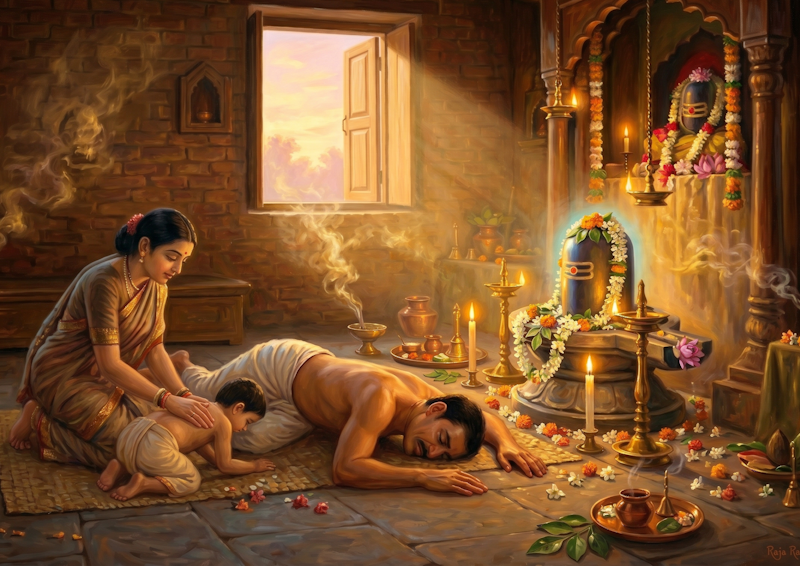
He prostrated before the Shivalinga. Full length, forehead to the floor.
And then he did not pray the way he usually prayed. He did not offer flowers or milk or a composed recitation. He broke. He wept — the way a man weeps when he has exhausted every other option and only truth is left.
Hey Prabhu. Hey Shankara. Save my child.
Then Priya came in.
She had reached the end of her patience, and her pain expressed itself as anger — at Siddhartha, at his altar, at the years of morning pujas and mantra chantings and flowers and incense that had, from where she stood in that moment, failed to protect her son from an enemy they couldn’t even name in front of their doctors.
“Why do you do all this if he cannot save us? Stop this puja. He cannot protect his own devotee. You are wasting your time.”
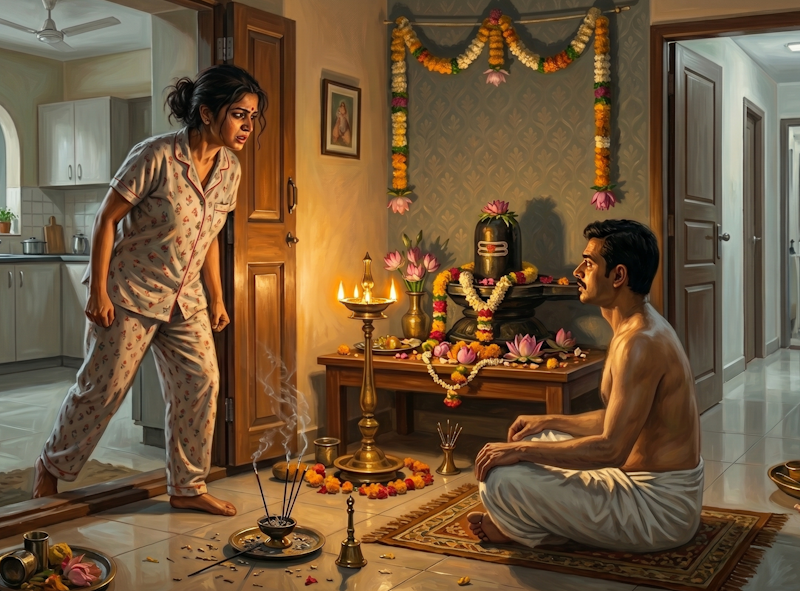
Siddhartha did not respond. He had heard worse things in his own mind in the past hour.
He rose from the floor. He went back to Prasanna. He gave the child another painkiller. And in the mercy of exhaustion, Prasanna slept. Siddhartha and Priya, both hollowed out by the night, finally slept too — around 4 in the morning.
4:30 AM
Three hours later, the maid rang the bell.
Siddhartha went to the door, still half in sleep, and found it already open.
He stood in the doorway for a moment before he registered this. He had locked that door himself last night. He was certain of it with the absolute certainty of a man who checks locks out of long habit. He did not dwell on it — he was tired, and there was a maid waiting — but the fact settled into some back register of his mind.
When Priya woke, their maid asked whether they had felt the earthquake. It had come at approximately 4:30 AM. The maid had felt the trembling in her own home. Priya said they had been asleep and felt nothing.
And then Siddhartha began to connect what he had not yet allowed himself to connect.
The door — locked the night before — standing open.
The earthquake at 4:30 AM.
His prayer before the Shivalinga: If you exist. If you are truly pleased with my devotion. Then come. Come physically. And save my child.
He had prayed for a physical visitation. He had asked the Lord to make Himself present in the room, not as metaphor, not as spiritual comfort, but as a force that moved in the world. And at 4:30 AM, the earth had moved.
Goosebumps rose across his skin.
The Test
Priya was still in that space of not-quite-believing, still raw from the night, still carrying the accumulated grief of watching her son suffer. Her voice, when she spoke, was sharp and sarcastic — the armor of someone who is afraid to hope.
“So Lord Shiva himself came to save your child? Is that what you think?”
She paused, then added — almost contemptuous, almost a dare: “Go to your son. Wake him up. See whether he is fine.”
Siddhartha walked to Prasanna’s room.
He stood at the door for a moment. This was, he understood with every fiber of his devotion, the moment. Not the prayer. Not the earthquake. This.
He went in.
“Prasanna. How are you?”
“Fine, Papa.”
Siddhartha’s heart stopped and restarted.
“Does your leg hurt?”
“No, Papa.”
Priya was listening from the hallway. She had not moved from outside the door. In the silence that followed Prasanna’s words, her voice came again — different now, softer, still sarcastic but cracking at the edges: “Can you run to me?”
What happened next gave goosebumps to a woman who did not believe in goosebumps.
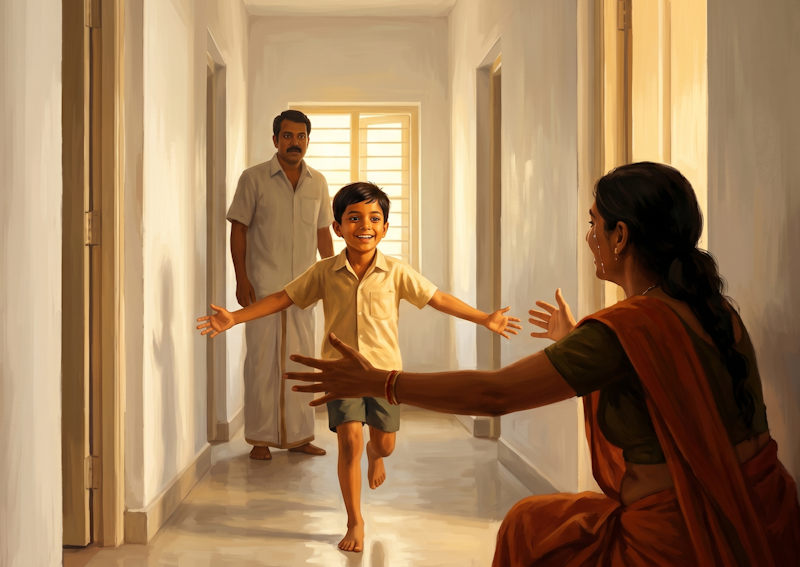
Prasanna got up. He ran. Not walked, not limped — ran, with the unthinking ease of a child for whom legs are simply instruments of joy, across the room and into the hallway and into his mother’s arms.
शिवः सदा सहायते
Priya held her son. And she wept.
Not the hard weeping of the night before — the weeping of a woman in unbearable helplessness. This was different. This was the weeping of someone whose entire map of the world has just been quietly redrawn by a hand she cannot see.
The whole family went to the puja room. They prostrated before the Shivalinga — all of them, including the woman who had stood in that same room hours ago and told her husband to stop wasting his time with his puja.
Priya spoke to the Shivalinga directly. Her voice was not composed.
“Hey Shiva — forgive me. I said terrible things against you. And you still came. You still saved my child. Forgive me.”
Siddhartha pressed his forehead to the floor and wept his gratitude in the only words that felt equal to the moment:
“You are an ocean of compassion. You came to our home. You proved it with your own presence — शिवः सदा सहायते. You never leave your devotees unheard. Never.”
What Aman Said
Siddhartha called Aman.
He told him everything — the door, the earthquake, the running child. There was a silence on the other end. Then Aman spoke.
“I was working the rituals through the night, you know that. And then, around 4:30 AM, something happened that I have rarely experienced. A massive force entered the space where I was working — not from any human practitioner. It was of a different order entirely. It began directly engaging and dismantling the negative energy that had been sent toward Prasanna. For about ten minutes, all the doors and windows in my room crackled and rattled, as though something of immense power was moving through. And then, around 5 AM, everything went quiet. Everything was still. And I knew.”
He paused.
“I knew Prasanna was safe. I knew the Lord had intervened. I didn’t call because I knew you would call me once you saw for yourself. I was waiting.”
What This Story Teaches
The Shiva Purana speaks of the Lord’s nature with a single phrase that contains everything: He is Āśutoṣa — the one who is easily pleased, and equally easily moved to protect. But there is a deeper teaching embedded in this phrase. Āśutoṣa does not mean that the Lord comes to every prayer spoken from comfort. He comes to the prayer spoken from the floor. He comes when all other supports have been removed and what remains is pure, naked, unconditional love — not prayer for protection, not prayer for comfort, but the prayer of a soul that loves simply because it loves.
Siddhartha’s devotion was never transactional. Through years of morning pujas, he never sat before the Shivalinga and bargained. He offered water and flowers and fire and himself — not in exchange for anything, but because this is what it means to love the Lord. And on the worst night of his life, when his faith was publicly questioned by his wife and quietly shaken in his own heart, he still went to the Shivalinga. Not because he was certain. Because he had nowhere else to go — and because Shiva was where he had always gone.
That is bhakti. Not the bhakti of certainty, but the bhakti that persists through doubt.
The Maha Mrityunjaya Mantra calls upon the Lord as the one who liberates us from death as a gardener frees a ripe fruit from the vine — urvārukamiva bandhanan mṛtyor mukṣīya mā’mṛtāt. Siddhartha’s son was not liberated from death that night. He was liberated from suffering. But the liberating force was identical: the same Lord, the same compassion, the same response to a heart that would not let go.
The Vayaviya Samhita of the Shiva Purana states that Shiva is sarvabhūtahite rataḥ — perpetually absorbed in the welfare of all beings. This is not a poetic claim. It is a cosmological principle. The Lord’s nature is compassion. It requires no coaxing. It only requires that we show up — fully, honestly, without pretense — and call.
That night in Howrah, a man showed up fully. And the earth itself answered.
A Final Word
Priya is not the woman she was before that night. She does not rush past the puja room in the mornings the way she once did. Sometimes, when the house is quiet, she lights the deepam herself.
Prasanna plays cricket with both legs, full speed, no memory of pain.
And Siddhartha still begins each day the same way he always has — water on the Shivalinga, mantra on his lips, flowers on the stone. Except now, he knows with a certainty that cannot be argued with, cannot be rationalized away, cannot be dissolved by any skepticism: the One he worships is not an idea. Not a metaphor. Not a cultural inheritance.
He walks through doors.
ॐ नमः शिवाय।
शिवः सदा सहायते।
This is such a beautiful testament to your perseverance. Thank you for being vulnerable and showing that there is light at the end of the tunnel.