
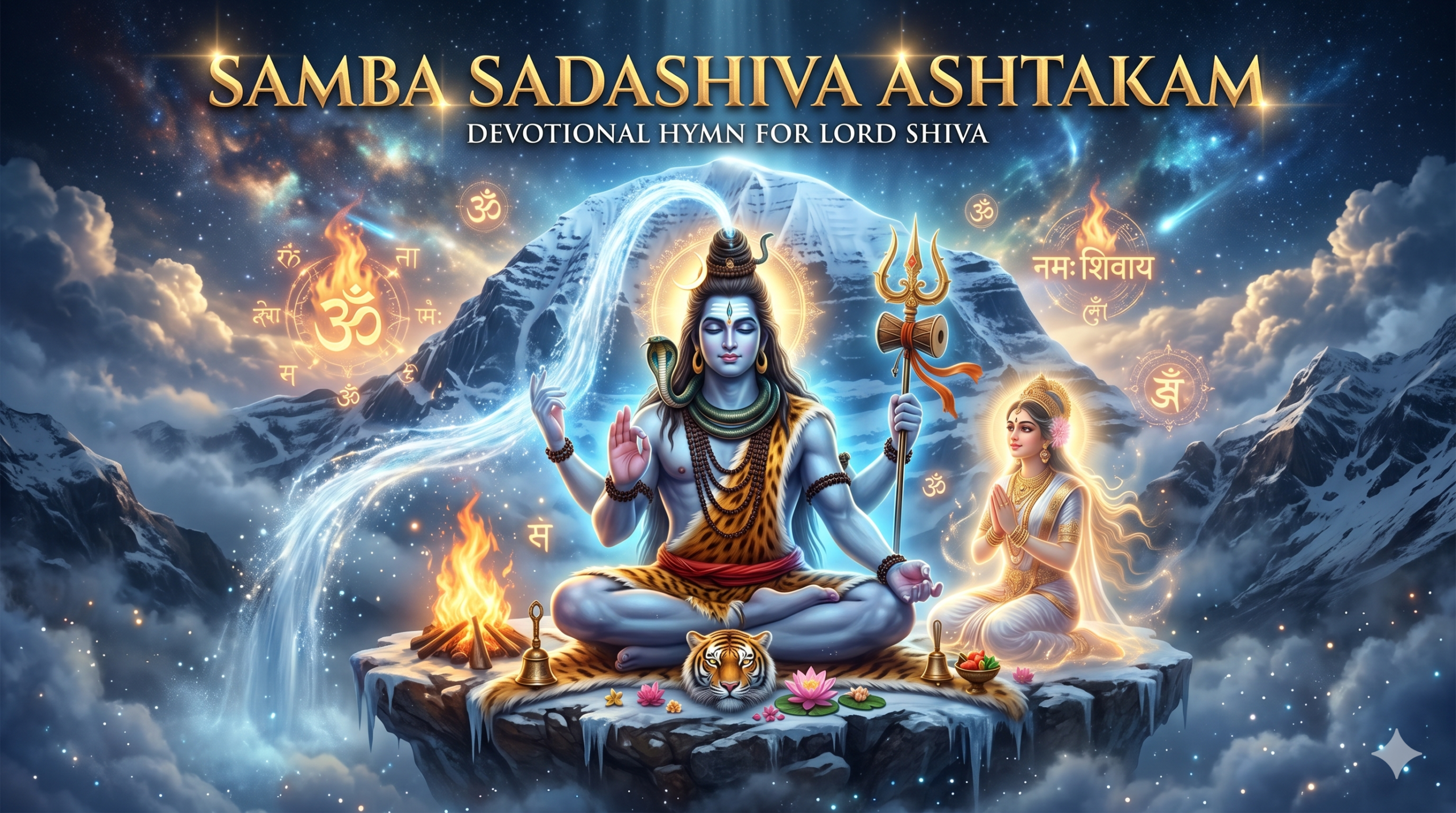
ॐ नमः शिवाय — In the name of the eternal Lord Shiva and the Divine Mother Parvati, we begin.
Introduction — A Stotram Born from the Heart of a Devotee
There are stotrams that are studied, and there are stotrams that are lived.
The Shri Samba Sadashiva Ashtakam (श्रीसाम्बसदाशिवाष्टकम्) belongs to the second kind. Composed as an entirely original Sanskrit hymn in the classical Anushtubh metre — the same sacred metre used in the Ramayana, the Mahabharata, and countless ancient hymns — this ashtakam is a devotee’s complete offering to the divine couple: Lord Shiva (Sadashiva) and Goddess Parvati (Gauri).
What makes this stotram unique is not just its beauty or its metre. It is built on a rare acrostic structure — each verse begins with a syllable of the sacred name SAMBA SADASHIVA (साम्बसदाशिव) — so that the very act of chanting the verses spells out the Lord’s name syllable by syllable. Every verse has four lines, alternating between praise of Shiva and praise of Parvati, weaving them together in a sacred conversation that reflects their inseparable divine unity. And every verse closes with the heartfelt refrain:
वन्दे शम्भुं च पार्वतीम् Vande Shambhum cha Parvatim “I salute Shambhu and Parvati”
This post presents the complete stotram with full Sanskrit text, transliteration, Hindi meaning, English meaning, and the spiritual significance of each verse — so that every devotee can chant it, understand it, and carry it in their heart.
What Does “Samba Sadashiva” Mean?
Before we enter the stotram, let us understand the sacred name it is built upon.
Samba (साम्ब) is a Sanskrit compound:
- Sa (स) = with / together with
- Amba (अम्बा) = Mother, referring to Goddess Parvati (also called Amba, the Divine Mother)
So Samba = “He who is with Amba (Parvati)” — a name that recognizes Lord Shiva not as a solitary ascetic but as the eternal companion of the Divine Mother. It is a name of love, of union, of completeness.
Sadashiva (सदाशिव) means:
- Sada (सदा) = always, eternally
- Shiva (शिव) = the auspicious one, the supreme reality
So Sadashiva = “The eternally auspicious one” — the Lord who is not merely auspicious in certain moments or for certain people, but whose very nature is auspiciousness without beginning or end.
Together, Samba Sadashiva means: “The eternally auspicious Lord who is always with the Divine Mother.” It is perhaps the most complete name of Shiva — honouring both his transcendent nature and his intimate relationship with Shakti.
What is an Ashtakam?
An Ashtakam (अष्टकम्) literally means “a group of eight” — it is a classical Sanskrit hymn structure consisting of eight verses. The tradition of composing ashtakams is ancient and deeply devotional. Famous ashtakams include:
- Rudrashtkam — composed by Tulsidas, glorifying the fierce form of Rudra
- Shivashtkam — eight verses on the beauty of Shiva
- Lingashtkam — eight verses glorifying the Shivalinga
- Mahishasura Mardini Ashtakam — glorifying Goddess Durga
The Shri Samba Sadashiva Ashtakam follows this sacred tradition with one unique addition: it honors both Shiva and Parvati together in every single verse, making it a complete Ardhanarishvara prayer — a prayer to the divine masculine and divine feminine as one.
The Structure of This Ashtakam — What Makes It Special
This stotram has three unique architectural features that set it apart from most existing compositions:
1. The Acrostic (Varnamala Stotra)
Each of the seven main verses begins with a successive syllable of साम्बसदाशिव:
| Verse | Opening Syllable | Sanskrit |
|---|---|---|
| Verse 1 | सा (Saa) | सानन्दं चन्द्रमौलिनं… |
| Verse 2 | म (Ma) | मातरं विश्वजननीं… |
| Verse 3 | ब (Ba) | बालेन्दुमौलिनं शम्भुं… |
| Verse 4 | स (Sa) | सतीं शैलसुतां दिव्यां… |
| Verse 5 | दि (Di) | दिगम्बरं महायोगिं… |
| Verse 6 | शि (Shi) | शिवां मङ्गलदात्रीं… |
| Verse 7 | व (Va) | वरेण्यं विश्वनायकं… |
| Verse 8 | Phala Shruti | साम्बसदाशिवाष्टकं… |
When you chant the opening syllables of each verse in sequence, you are chanting the Lord’s name: सा-म-ब-स-दि-शि-व = साम्बसदाशिव. The stotram itself becomes a mala (garland) of the divine name.
2. The Alternating Shiva-Parvati Pattern
Each verse has four lines (two shlokas):
- Odd verses (1, 3, 5, 7): Lines 1–2 praise Shiva · Lines 3–4 praise Parvati
- Even verses (2, 4, 6): Lines 1–2 praise Parvati · Lines 3–4 praise Shiva
This creates a beautiful rhythmic alternation — like two voices in a sacred conversation, or like the in-breath and out-breath of a single cosmic being. Shiva and Parvati are never separated; they complete each other in every verse.
3. The Refrain — Vande Shambhum Cha Parvatim
Every verse closes with the same refrain:
वन्दे शम्भुं च पार्वतीम्
The word वन्दे (Vande) carries deep weight in Sanskrit devotion — it is the same root as Vande Mataram and Vandanam. It means not merely “I bow” but “I salute with complete reverence from my entire being.” This refrain, repeated eight times, becomes a mantra of surrender to the divine couple.
The Complete Stotram — Lyrics, Transliteration & Meaning
॥ Verse 1 ॥ — सानन्दं चन्द्रमौलिनम्
Theme: Saundarya Varnanam — The United Radiance of Shiva and Parvati Acrostic syllable: सा (Saa)
सानन्दं चन्द्रमौलिनं सार्धं शक्त्या विराजितम् ।
सर्पभूषं त्रिनेत्रं तं सर्वलोकमहेश्वरम् ॥
सालङ्कारां महादेवीं सौन्दर्यस्य प्रतीकिनीम् ।
सर्वमङ्गलमाङ्गल्यां वन्दे शम्भुं च पार्वतीम् ॥१॥
Transliteration: Saanandaṃ candra-maulinaṃ saardhaṃ shaktyaa viraajitam | Sarpa-bhuushaṃ tri-netraṃ taṃ sarva-loka-maheshvaram || Saalaṅkaaraṃ mahaadeviiṃ saundaryasya pratikinim | Sarva-maṅgala-maaṅgalyaaṃ vande shambhuṃ cha parvatim ||1||
English Meaning: Shiva (Lines 1-2): I salute the blissful Lord who wears the crescent moon as his crown, resplendent alongside his Shakti; adorned with serpents, three-eyed, the great sovereign of all the worlds.
Parvati (Lines 3-4): The beautifully adorned Mahadevi, the very embodiment of beauty; she who is the auspiciousness of all that is auspicious — I salute Shambhu and Parvati.
Hindi Meaning: शिव (पंक्ति 1-2): जो आनन्दमय हैं, जिनके मस्तक पर चन्द्रमा का मुकुट है, जो अपनी शक्ति के साथ विराजमान हैं; जिनके आभूषण सर्प हैं, जो त्रिनेत्रधारी हैं और समस्त लोकों के महान ईश्वर हैं।
पार्वती (पंक्ति 3-4): जो सुसज्जित महादेवी हैं, सौन्दर्य की साक्षात् प्रतिमा हैं; जो सर्वमङ्गलमाङ्गल्या हैं — मैं शम्भु और पार्वती की वन्दना करता हूँ।
Spiritual Significance: This opening verse sets the tone of the entire stotram. Shiva is described as saananda — blissful — not in isolated ascetic bliss, but blissful saardham shaktyaa — together with his Shakti, Parvati. The crescent moon (candra-mauli), the serpent (sarpa-bhusha), and the third eye (tri-netra) are not mere ornaments — they represent time, the cycle of death and rebirth, and the fire of transcendent wisdom respectively. Parvati is called sarva-mangala-maangalya — the auspiciousness of all that is auspicious. This is a Vedic title of extraordinary depth: she is not merely auspicious herself, but is the very source from which all auspiciousness in the universe flows.
॥ Verse 2 ॥ — मातरं विश्वजननीम्
Theme: Matru Mrityunjaya Varnanam — The Universal Mother and the Conqueror of Death Acrostic syllable: म (Ma)
मातरं विश्वजननीं माहेश्वरीं कृपामयीम् ।
महाशक्तिं महामायां महाविद्यां सनातनीम् ॥
महेशं भक्तवत्सलं मनोज्ञं नीलकण्ठं तम् ।
मृत्युञ्जयं महादेवं वन्दे शम्भुं च पार्वतीम् ॥२॥
Transliteration: Maataraṃ vishva-jananiiṃ maaheshvariim krpaamayim | Mahaa-shaktiṃ mahaa-maayaaṃ mahaa-vidyaaṃ sanatanim || Maheshaṃ bhakta-vatsalaṃ manojñaṃ nila-kaṇṭhaṃ tam | Mṛtyuñjayaṃ mahaadevam vande shambhuṃ cha parvatim ||2||
English Meaning: Parvati (Lines 1-2): The Mother, the universal creatrix, Maheshvari full of compassion; the great Shakti, the great Maya, the great Vidya — the eternal one.
Shiva (Lines 3-4): Mahesh who cherishes his devotees like his own children, the enchanting blue-throated Lord; Mrityunjaya — the conqueror of death, the Mahadeva — I salute Shambhu and Parvati.
Hindi Meaning: पार्वती (पंक्ति 1-2): जो विश्व की माता हैं, समस्त जगत की जननी हैं, माहेश्वरी हैं, कृपा से परिपूर्ण हैं; जो महाशक्ति, महामाया, महाविद्या और सनातनी हैं।
शिव (पंक्ति 3-4): जो महेश हैं, भक्तों पर पुत्रवत् स्नेह रखते हैं, मनमोहक नीलकण्ठ हैं; जो मृत्युञ्जय हैं, महादेव हैं — मैं शम्भु और पार्वती की वन्दना करता हूँ।
Spiritual Significance: In this verse, Parvati is given three of her most cosmic titles: Mahashakti (the supreme cosmic energy), Mahamaya (the great illusion that creates and sustains the universe), and Mahavidya (the great wisdom that liberates from that same illusion). She is simultaneously the power that binds and the wisdom that frees — just as a mother both holds her child and teaches it to walk alone. Shiva is here the Mrityunjaya — literally “the victor over death.” His blue throat (Neelakantha) reminds us that he swallowed the halahala (cosmic poison) during Samudra Manthan to save all creation — a supreme act of compassion that left a permanent blue mark on his throat, worn as a badge of sacrifice.
॥ Verse 3 ॥ — बालेन्दुमौलिनं शम्भुम्
Theme: Bahurupa Moksha Varnanam — Cosmic Form and the Liberatrix Acrostic syllable: ब (Ba)
बालेन्दुमौलिनं शम्भुं भस्मोद्धूलितविग्रहम् ।
बहुरूपं जगन्नाथं भवभञ्जनमीश्वरम् ॥
बन्धमोक्षप्रदां शक्तिं भवानीं लोकमातरम् ।
बालां हिमगिरेः पुत्रीं वन्दे शम्भुं च पार्वतीम् ॥३॥
Transliteration: Baalendu-maulinaṃ shambhuṃ bhasmodhuulita-vigraham | Bahu-ruupaṃ jagan-naathaṃ bhava-bhañjanam-ishvaram || Bandha-moksha-pradaaṃ shaktiṃ bhavaaniim loka-maataram | Baalaaṃ himagireḥ putriim vande shambhuṃ cha parvatim ||3||
English Meaning: Shiva (Lines 1-2): Shambhu who wears the young crescent moon upon his head, whose body is smeared with sacred ash; the Lord of many forms, sovereign of the world, the destroyer of worldly bondage.
Parvati (Lines 3-4): The Shakti who grants liberation from all bonds, Bhavani — the Mother of the world; the youthful daughter of the snow-clad mountain — I salute Shambhu and Parvati.
Hindi Meaning: शिव (पंक्ति 1-2): जिनके मस्तक पर बालचन्द्र सुशोभित है, जिनका शरीर भस्म से विभूषित है; जो बहुरूपधारी हैं, जगन्नाथ हैं, भव के बन्धनों का नाश करने वाले ईश्वर हैं।
पार्वती (पंक्ति 3-4): जो बन्धन से मुक्ति प्रदान करने वाली शक्ति हैं, भवानी हैं, लोकमाता हैं; हिमगिरि की सुकुमार पुत्री हैं — मैं शम्भु और पार्वती की वन्दना करता हूँ।
Spiritual Significance: Here is the deep paradox of Shiva beautifully captured: He is bahurupa (of many forms — Nataraja, Dakshinamurti, Rudra, Vaidyanatha, Bhairava) yet he is one. He is bhava-bhanjana — the destroyer of bhava (worldly existence/cycle of birth and death) — yet Parvati is called bhavani — she who gives life to bhava, who sustains the very world that Shiva transcends. Together they are the complete truth: he is the stillness at the center, she is the dance at the circumference. The sacred ash (bhasma) with which Shiva smears his body represents the ultimate truth of Vedanta: everything returns to ash, everything is impermanent — yet consciousness remains.
॥ Verse 4 ॥ — सतीं शैलसुताम्
Theme: Sati Sadashiva Varnanam — The Divine Consort and the Eternal Lord Acrostic syllable: स (Sa)
सतीं शैलसुतां दिव्यां सौभाग्यस्य प्रदायिनीम् ।
सर्वशक्तिमयीं देवीं सिंहवाहनसुन्दरीम् ॥
सदानन्दं सदाशान्तं सर्वज्ञं ज्ञानदायकम् ।
सर्वेशं पार्वतीकान्तं वन्दे शम्भुं च पार्वतीम् ॥४॥
Transliteration: Satiiṃ shaila-sutaaṃ divyaaṃ saubhaagyasya pradaayinim | Sarva-shaktimayiiṃ deviiṃ simha-vaahana-sundariim || Sadaanandaṃ sadaa-shaantaṃ sarvajñaṃ jñaana-daayakam | Sarveshaṃ paarvatii-kaantaṃ vande shambhuṃ cha parvatim ||4||
English Meaning: Parvati (Lines 1-2): The divine Sati, the radiant daughter of the mountain king, the bestower of all good fortune; the Devi in whom all powers reside, beautiful upon her lion mount.
Shiva (Lines 3-4): The Lord who is eternally blissful and ever peaceful, omniscient, the giver of wisdom; the sovereign of all, the beloved husband of Parvati — I salute Shambhu and Parvati.
Hindi Meaning: पार्वती (पंक्ति 1-2): जो सती हैं, पर्वतराज की दिव्य पुत्री हैं, सौभाग्य प्रदान करने वाली हैं; जो सर्वशक्तिमयी देवी हैं, सिंह पर विराजमान सुन्दरी हैं।
शिव (पंक्ति 3-4): जो सदा आनन्दमय हैं, सदा शान्त हैं, सर्वज्ञ हैं, ज्ञान के दाता हैं; जो सर्वेश्वर हैं, पार्वती के प्रियतम हैं — मैं शम्भु और पार्वती की वन्दना करता हूँ।
Spiritual Significance: Parvati’s title Sati carries the most profound story in all of Shaivism — she was the daughter of Daksha who chose Shiva as her husband against her father’s wishes, and ultimately gave her life at Daksha’s yagya (sacrifice) when her husband was insulted. Her rebirth as Parvati, daughter of the Himalayas, and her fierce tapasya (austerities) to win Shiva back represents the journey of every devotee — the soul’s unwavering love for the Supreme even through death and rebirth. Shiva as Sarvesha Parvati-kanta — the sovereign of all who is also the devoted husband of Parvati — shows that the highest power and the deepest love are not opposites. They coexist in Shiva.
॥ Verse 5 ॥ — दिगम्बरं महायोगिम्
Theme: Digambara Dipti Varnanam — The Sky-Clad Yogi and the Luminous Goddess Acrostic syllable: दि (Di)
दिगम्बरं महायोगिं दीनबन्धुं दयापरम् ।
दिव्यतेजस्विनं शम्भुं दक्षयज्ञविनाशनम् ॥
दिव्यां शैलसुतां देवीं दीप्तां दाक्षायणीं पराम् ।
दिशां सर्वां प्रकाशन्तीं वन्दे शम्भुं च पार्वतीम् ॥५॥
Transliteration: Digambaraṃ mahaa-yogiṃ diina-bandhuṃ dayaa-param | Divya-tejasvinaṃ shambhuṃ daksha-yajña-vinaashanam || Divyaaṃ shaila-sutaaṃ deviiṃ diiptaaṃ daakshaayaniim paraam | Dishaaṃ sarvaaṃ prakaashantiiṃ vande shambhuṃ cha parvatim ||5||
English Meaning: Shiva (Lines 1-2): The sky-clad (Digambara) supreme Yogi, the friend of the destitute, the supremely compassionate; the divinely radiant Shambhu, the destroyer of Daksha’s sacrifice.
Parvati (Lines 3-4): The divine daughter of the mountain, the luminous Dakshayani, the supreme one; she who illuminates all the directions of the universe — I salute Shambhu and Parvati.
Hindi Meaning: शिव (पंक्ति 1-2): जो दिगम्बर हैं, महायोगी हैं, दीनों के बन्धु हैं, परम दयालु हैं; जो दिव्य तेज से प्रकाशमान शम्भु हैं, दक्ष के यज्ञ का विनाश करने वाले हैं।
पार्वती (पंक्ति 3-4): जो दिव्य हैं, पर्वतराज की पुत्री हैं, दीप्तिमान दाक्षायणी हैं, परम श्रेष्ठ हैं; जो सम्पूर्ण दिशाओं को प्रकाशित करती हैं — मैं शम्भु और पार्वती की वन्दना करता हूँ।
Spiritual Significance: Digambara — clothed in the sky, clothed in nothing — is one of the most profound epithets of Shiva. The sky has no limits, no beginning, no end. It accommodates everything without being stained by anything. To be clothed in the sky is to be beyond all limitation, all conditioning, all identity. This is the ultimate vairagya — not the renunciation of a man who has rejected the world, but the natural state of one who has always been free. Yet this same Digambara is also Dina-bandhu — the friend of the destitute. The highest renunciation and the deepest compassion live together in Shiva. Parvati as Dakshayani, illuminating all ten directions, represents the truth that Shakti is light itself — the very consciousness that makes seeing possible.
॥ Verse 6 ॥ — शिवां मङ्गलदात्रीम्
Theme: Mangala Guru Varnanam — Auspiciousness and the Guru of All Acrostic syllable: शि (Shi)
शिवां मङ्गलदात्रीं तां शिखरेशसुतां वराम् ।
शिशुचन्द्रप्रभां देवीं शिवकान्तां सनातनीम् ॥
शिवं शान्तं त्रिशूलिनं शिरसि शशिशेखरम् ।
शिष्टानां शरणं देवं वन्दे शम्भुं च पार्वतीम् ॥६॥
Transliteration: Shivaaṃ maṅgala-daatriim taaṃ shikharesha-sutaaṃ varaam | Shishu-candra-prabhaaṃ deviiṃ shiva-kaantaaṃ sanatanim || Shivaṃ shaantaṃ tri-shuulinaṃ shirasi shashi-shekharam | Shishtaanaaṃ sharanaṃ devaṃ vande shambhuṃ cha parvatim ||6||
English Meaning: Parvati (Lines 1-2): Shiva (the auspicious one), the bestower of all mangala, the excellent daughter of the Lord of Peaks (Himalaya); radiant as the young moon, the eternal beloved of Shiva.
Shiva (Lines 3-4): The auspicious, the serene, the trident-bearer who wears the moon-crest upon his head; the refuge of the righteous — I salute Shambhu and Parvati.
Hindi Meaning: पार्वती (पंक्ति 1-2): जो शिवा हैं (मङ्गलदायिनी), सब मङ्गलों की दात्री हैं, पर्वतशिखर के ईश की श्रेष्ठ पुत्री हैं; जो बालचन्द्र के समान प्रभावाली हैं, शिव की सनातन प्रिया हैं।
शिव (पंक्ति 3-4): जो शिव हैं, शान्त हैं, त्रिशूलधारी हैं, जिनके शिर पर शशि (चन्द्रमा) का मुकुट है; जो सज्जनों की शरण हैं — मैं शम्भु और पार्वती की वन्दना करता हूँ।
Spiritual Significance: Notice the extraordinary symmetry of this verse: Parvati is called Shiva (feminine — the auspicious one) and Shiva himself is called Shiva (masculine). They share the same name. In Sanskrit philosophy this is not coincidence — it is a declaration that they are not two separate beings who happen to love each other, but one reality that has taken two forms for the joy of divine love (lila). The Trishula (trident) of Shiva represents his mastery over the three gunas (sattva, rajas, tamas), the three states of consciousness (waking, dreaming, deep sleep), and the three dimensions of time (past, present, future). He who holds the trident is beyond all three.
॥ Verse 7 ॥ — वरेण्यं विश्वनायकम्
Theme: Vishvesh Varnanam — Supreme Sovereignty and Universal Grace Acrostic syllable: व (Va)
वरेण्यं विश्वनायकं वरदं भक्तसेविनम् ।
विश्वेश्वरं विरूपाक्षं वैराग्यस्य महागुरुम् ॥
वरां हैमवतीं शक्तिं वत्सलां विश्वमातरम् ।
विमलां पुण्यचरितां वन्दे शम्भुं च पार्वतीम् ॥७॥
Transliteration: Vareṇyaṃ vishva-naayakaṃ varadaṃ bhakta-sevinam | Vishveshvaraṃ viruupaakshaṃ vairaagyasya mahaa-gurum || Varaaṃ haimavatiiṃ shaktiṃ vatsalaaṃ vishva-maataram | Vimalaaṃ puṇya-caritaaṃ vande shambhuṃ cha parvatim ||7||
English Meaning: Shiva (Lines 1-2): The most excellent, the sovereign of the universe, the boon-granter who serves his devotees; Vishveshvara, Virupaksha (the odd-eyed one), the supreme guru of renunciation.
Parvati (Lines 3-4): The auspicious Haimavati (daughter of the Himalaya), the Shakti, the affectionate Mother of all worlds; the spotless one of sacred deeds — I salute Shambhu and Parvati.
Hindi Meaning: शिव (पंक्ति 1-2): जो सर्वश्रेष्ठ हैं, विश्व के नायक हैं, भक्तों की सेवा करने वाले वरदाता हैं; जो विश्वेश्वर हैं, विरूपाक्ष हैं, वैराग्य के महागुरु हैं।
पार्वती (पंक्ति 3-4): जो श्रेष्ठ हैमवती हैं, शक्ति हैं, वात्सल्यमयी विश्वमाता हैं; जो विमल हैं, पवित्र चरित्र वाली हैं — मैं शम्भु और पार्वती की वन्दना करता हूँ।
Spiritual Significance: Virupaksha — literally “the odd-eyed one” — is a title full of esoteric depth. While all creation has paired organs (two eyes, two ears, two nostrils), Shiva has a third eye — the eye that sees without duality, that perceives the undivided truth beneath the surface of appearances. He is bhakta-sevina — one who serves his devotees. This is the ultimate inversion: the Lord of the universe serves those who love him. It is the secret of bhakti: when the devotee surrenders completely, the Lord becomes their servant. Parvati as Haimavati — daughter of the Himalayas — anchors the infinite into the earthly: the world’s highest mountain is her father, her family, her home. She is not distant or abstract but rooted in the very earth we walk upon.
॥ Verse 8 — Phala Shruti ॥
The Fruit of Recitation
साम्बसदाशिवाष्टकं यो भक्त्या पठते नरः ।
प्रातः सायं च मध्याह्ने नित्यं श्रद्धासमन्वितः ॥
गौरीशम्भुप्रसादेन सर्वपापक्षयं लभेत् ।
मोक्षमाप्नोति शाश्वतं वन्दे शम्भुं च पार्वतीम् ॥८॥
Transliteration: Saamba-sadaashivaashṭakaṃ yo bhaktyaa paṭhate naraḥ | Praataḥ saayaṃ ca madhyaahne nityaṃ shraddhaa-samanvitaḥ || Gaurii-shambhu-prasaadena sarva-paapa-kshayaṃ labhet | Moksham-aapnoti shaashvataṃ vande shambhuṃ cha parvatim ||8||
English Meaning: Whosoever recites this Samba Sadashiva Ashtakam with devotion — in the morning, at midday, and in the evening — ever endowed with faith, by the grace of Gauri and Shambhu, shall have all sins destroyed and shall attain eternal liberation (Moksha). I salute Shambhu and Parvati.
Hindi Meaning: जो मनुष्य इस साम्बसदाशिवाष्टकम् को भक्तिपूर्वक पढ़ता है — प्रातःकाल, मध्याह्न और सायंकाल — सदा श्रद्धा से युक्त होकर, गौरी और शम्भु की कृपा से उसके समस्त पापों का क्षय होता है और वह शाश्वत मोक्ष को प्राप्त करता है। मैं शम्भु और पार्वती की वन्दना करता हूँ।
॥ इति श्रीसाम्बसदाशिवाष्टकं सम्पूर्णम् ॥
How to Chant This Ashtakam — A Practical Guide
When to Chant
The Phala Shruti itself prescribes the timing:
- Pratahkal (प्रातःकाल) — At dawn, after bath and before food
- Madhyahna (मध्याह्न) — At noon, during midday prayers
- Sayankaal (सायंकाल) — At evening, during sandhya vandana
Even one recitation daily, done with full attention and devotion, is sufficient.
How to Prepare
- Sit facing East (morning) or North (evening)
- Light a diya (oil lamp) or incense if possible
- Have a Shivalinga, Shiva image, or simply close your eyes
- Take three deep breaths and silently say “Om Namah Shivaya” before beginning
Pronunciation Tips
- The refrain वन्दे शम्भुं च पार्वतीम् should be chanted slightly louder and more slowly than the verse lines, as it is the devotional anchor of each verse
- The acrostic syllables at the start of each verse (सा, म, ब, स, दि, शि, व) carry special weight — give them a moment of emphasis
- Do not rush. Anushtubh metre has a natural walking rhythm — let it breathe
The Right Spirit
No stotram works through mechanical repetition alone. The Shiv Puran says:
“Shivo bhavati bhaktanam” — Shiva becomes present for his devotees.
Chant with the understanding of what each word means. Let the images arise — the crescent moon, the ash-smeared form, Parvati radiant as the young moon, Bhavani liberating souls from bondage. Bhakti is not performance. It is the heart speaking to its source.
Why This Stotram Honors Both Shiva and Parvati Together
Most stotrams honor either Shiva or Parvati. This one honors both — in every single verse. This is deeply intentional.
The Ardhanari principle — Shiva-Shakti as one — is the foundation of Shaivite philosophy. The Shiv Puran states clearly:
“Shiva without Shakti is shava (a corpse). Shakti without Shiva has no direction.”
They are not two beings in love. They are one reality in two expressions — Shiva is pure consciousness (chit), Parvati is pure creative energy (shakti). Neither is complete without the other. When you honor one, you honor both. This ashtakam makes that unity explicit with every verse — two voices, one prayer, one love.
About the Author — Manu Siddhartha
This stotram is an original composition by Manu Siddhartha (मनु सिद्धार्थ), an ardent devotee of Lord Shiva and published author of works on Hindu philosophy and Sanskrit literature including:
- Shiv Puran Unlocked — Making the sacred Shiv Puran accessible to every devotee
- Hari Hara Unlocked — Exploring the unity of Shiva and Vishnu
- Shivoham: Discovering the Self Beyond the Self — Non-dual philosophy for the modern seeker
- Dark Tantra Unlocked — A spiritual thriller exploring Tantric traditions
- The Hidden Gods — The lesser-known deities of Sanatan Dharma
- Ramayana Unlocked — Textual criticism of the Valmiki Ramayana
Manu Siddhartha composes original Sanskrit stotrams as a personal act of devotion, in the living tradition of bhakti poetry that stretches from the Vedic rishis to the Nayanmars and Alvars. He believes that the Sanskrit devotional tradition is not a museum piece but a living language of the heart — and that new compositions in this tradition carry the same sacred energy as the ancient ones, because the Lord to whom they are addressed is the same, eternal Shiva.
“I do not compose these stotrams. I listen for them. They come from a place deeper than the mind — the place where Shiva already lives.” — Manu Siddhartha
Conclusion — A Living Stotram for Every Age
The Shri Samba Sadashiva Ashtakam is more than a collection of beautiful Sanskrit verses. It is a complete devotional map:
- Verse 1 shows you how to see Shiva and Parvati — their divine beauty
- Verse 2 shows you what to ask of them — compassion, wisdom, victory over death
- Verse 3 shows you what they offer — liberation from all bondage
- Verse 4 shows you how they relate to each other — as eternal divine lovers
- Verse 5 shows you the depth of their nature — sky-clad detachment and cosmic radiance
- Verse 6 shows you their grace — auspiciousness flowing from the Goddess, refuge offered by the Lord
- Verse 7 shows you their sovereignty — the ultimate reality and the World-Mother
- Verse 8 promises you the fruit — by their grace, all sins dissolve and moksha comes
Chant it once with understanding and you will want to chant it again. Chant it daily and you will find it chanting itself inside you — in the background of every moment, like a river that never stops flowing.
हर हर महादेव 🔱 जय माँ पार्वती 🙏
वन्दे शम्भुं च पार्वतीम्